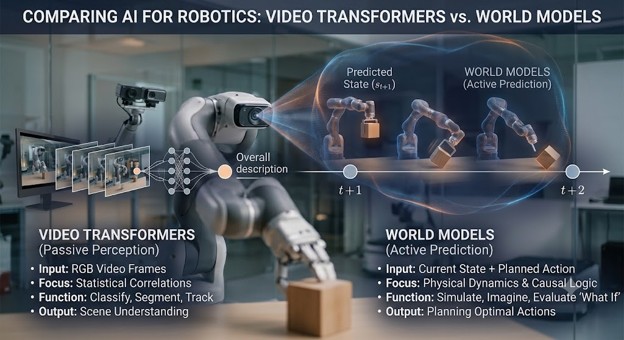
Video Transformers revolutionized computer vision by bringing self-attention to temporal sequences, enabling AI to model complex, long-range dynamics across video frames. This shift supercharged activity detection, action recognition, and temporal segmentation—allowing models to perceive what was happening in a scene with unprecedented accuracy.
Yet, despite their perceptual power, Video Transformers remain passive observers. They identify statistical correlations in past frames, but cannot reason about physical causality or action outcomes.
This limitation sparked the advent of World Models. Building upon the feature-rich spatial representations learned by transformers, world models bridge the gap between passive vision and active control. By learning an internal simulator of physical reality, world models enable autonomous agents to project future states based on planned actions. Instead of merely classifying what already occurred, agents can now simulate "what if" scenarios, evaluating consequences in neural space before taking a single physical action.
The Core Concept Behind World Models#
Humans do not solve differential equations to catch a falling cup; we rely on an intuitive mental model of gravity, trajectory, and physical dynamics built through observation and interaction. A world model is the neural equivalent of this internal simulator.
Instead of treating video frames as isolated statistical patterns, a world model learns the underlying causal dynamics of an environment. Given the current state of the world (st) and a proposed action (at), the world model predicts the resulting state of the world (st+1). By projecting these predictions multiple steps into the future—a process often called "imagination"—the agent can plan optimal sequences of actions entirely within its neural simulation before executing them in the real world.
Where World Models Are Used#
Training physical hardware directly in real-world environments is slow, wear-and-tear heavy, and dangerous. World models allow robots to perform millions of trial-and-error iterations inside a learned internal simulator, achieving zero-shot control in novel environments.
Self-driving platforms (such as Wayve's GAIA-1 or Waymo's world models) use learned dynamics to simulate rare, dangerous edge cases—like sudden weather shifts or erratic pedestrian behaviors—without risking safety on public roads.
Interactive foundation models like DeepMind's Genie series and NVIDIA's Cosmos generate real-time, playable environments driven by text prompts or action inputs.
Base Architecture of a World Model#
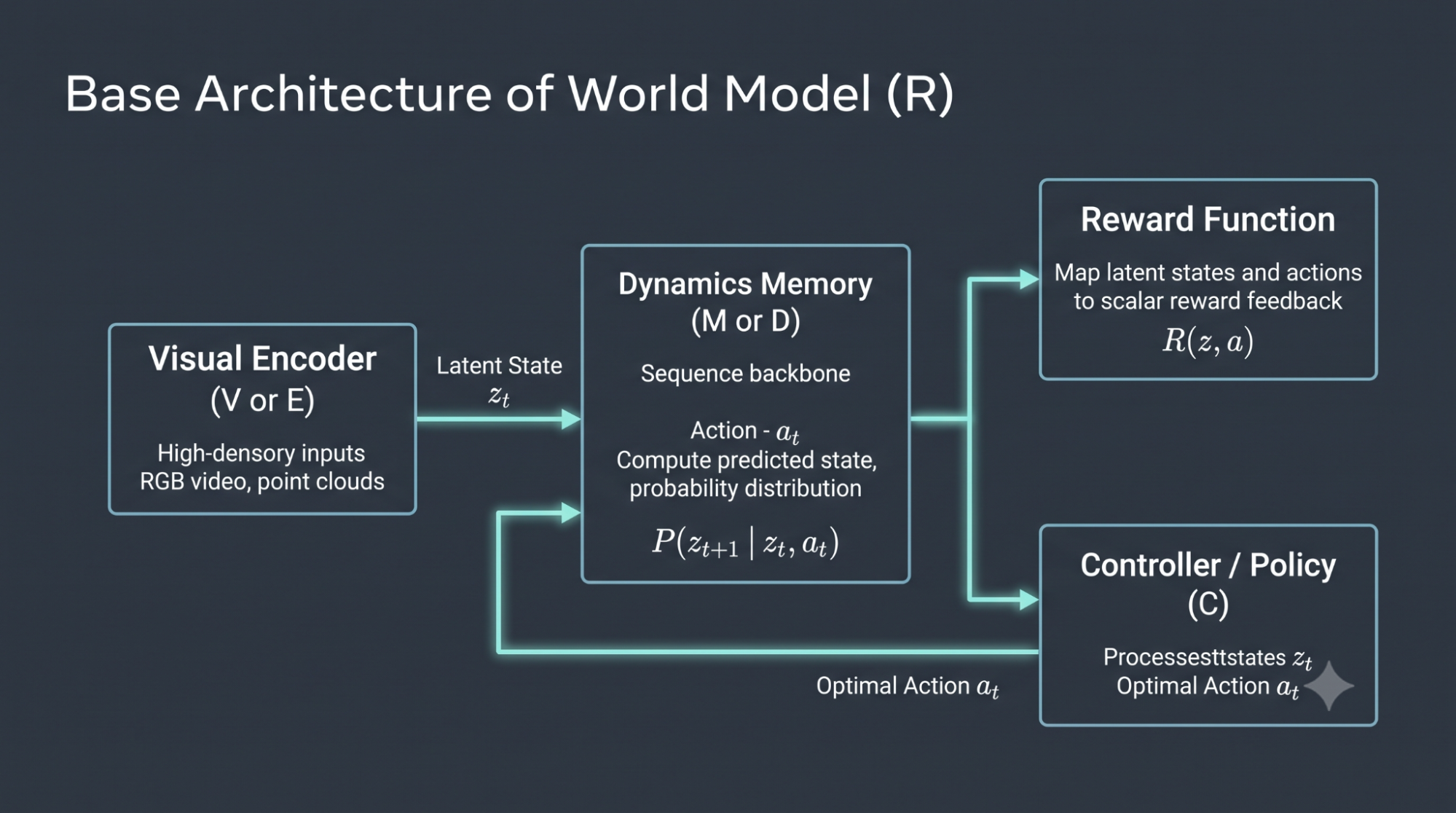
Most modern world models build upon the foundational blueprint consisting of three interconnected modules:
- Visual Encoder (V or E): Takes high-dimensional sensory inputs (such as RGB video frames or point clouds) and compresses them into a compact, low-dimensional latent state zt.
-
Dynamics Memory (M or D): A sequence backbone (using Recurrent Neural Networks, State-Space Models, or Transformers) that models how the latent state evolves over time given an action atzt+1 ~ P(zt+1 | zt, at)
- Reward Function (R): A reward function that maps an agent's internal latent states or transitions and actions to a scalar feedback signal, R(z, a), guiding policy optimization and planning
- Controller / Policy (C or π): An agent network that reads the latent state zt (or imagined future states) and outputs the best action at to achieve a specified goal.
Major Types of World Model Architectures#
Combines deterministic recurrent memory (to track long-term sequences) with stochastic latent states (to capture real-world randomness). Rather than generating computationally expensive video frames, models like DreamerV3 simulate policies entirely inside abstract latent space.
Popularized by Meta FAIR (e.g., V-JEPA), JEPAs predict the abstract representations of future frames directly in embedding space rather than reconstructing raw pixels. This avoids spending computational budget on task-irrelevant pixel details like moving tree leaves or background noise.
Models like NVIDIA Cosmos or DeepMind's Genie treat world modeling as video generation conditioned on actions or text inputs. While resource-heavy, they act as full visual simulators for physical AI agents.
How World Models Differ from Video Transformers#
| Specific attribute | World Models | Video Transformers |
|---|---|---|
| Role | Active simulator - predicts what happens if I do X? | Passive observer - predicts what comes next in video? |
| Input → Output | State + Action → Next State (st, at → st+1) | Frames → Next Frames / Labels (xt → xt+1) |
| Focus | Physics & causality: momentum, collision, planning | Appearance & patterns: captioning, tagging, generation |
| Best for | Robotics, autonomous driving, planning & control | Video understanding, retrieval, generation |
| Examples | DreamerV3, V-JEPA, Cosmos, Genie, GAIA-1 | TimeSformer, ViViT, VideoMAE, InternVideo |
- Observation vs. Action: Video Transformers are passive observers; they learn statistical continuations of visual sequences (xt → xt+1). World Models are active, action-conditioned agents that ask: "If I apply force at, what state st+1 results?"
- Target Space: Standard Video Transformers generate tokens or pixels to produce visually convincing output. World Models prioritize predicting physical state transitions (like momentum, collisions, and spatial bounds), often discarding visual details that don't impact physical reality.
- Primary Objective: Video Transformers excel at perception tasks (video captioning, action tagging, visual generation). World Models excel at decision-making, policy optimization, and planning long-horizon motor controls.
The transition from static computer vision to world models marks the moment AI moves off our screens and into the physical world. While language models solved how AI processes human knowledge, world models are solving how AI navigates physical reality.
Which industry do you think will see the most immediate commercial breakthrough from world models first—autonomous transportation, surgical robotics, or industrial automation? We would love to hear your thoughts below
Glossary of Key Terms#
- World Model
- A neural network that learns the causal dynamics of an environment, predicting the next state of the world given a current state and a proposed action.
- Latent State
- A compact, low-dimensional numerical representation of a high-dimensional sensory input, such as a video frame, produced by a visual encoder.
- Dynamics Memory
- The sequence backbone of a world model — an RNN, State-Space Model, or Transformer — that models how the latent state evolves over time given an action.
- Joint-Embedding Predictive Architecture (JEPA)
- A world model design, popularized by Meta's V-JEPA, that predicts future frames as abstract embeddings rather than reconstructing raw pixels.
- Recurrent State-Space Model (RSSM)
- An architecture, used in models like DreamerV3, combining deterministic recurrent memory with stochastic latent states to simulate policies in latent space.
- Reward Function
- A component that maps an agent's latent states, transitions, and actions to a scalar feedback signal, guiding policy optimization and planning.
- Controller / Policy
- The agent network within a world model that reads the current or imagined future latent state and outputs the best action to achieve a goal.
- Video Transformer
- A computer vision architecture that applies self-attention to video, enabling passive perception tasks like action recognition and captioning.
Frequently Asked Questions#
What is a world model in AI?
A neural network that learns an environment's causal dynamics, predicting the resulting next state from a current state and a proposed action — letting an agent plan inside a simulation before acting in reality.
How do world models differ from video transformers?
Video Transformers passively predict what comes next in a video. World Models actively predict what state results if an agent takes a specific action, prioritizing physical state transitions over visually convincing pixels.
What are the core modules of a world model architecture?
A Visual Encoder that compresses input into a latent state, a Dynamics Memory that models how that state evolves given an action, a Reward Function for feedback, and a Controller/Policy that outputs the best action toward a goal.
What is a Joint-Embedding Predictive Architecture (JEPA)?
A world model design, popularized by Meta's V-JEPA, that predicts future frames as abstract embeddings rather than raw pixels — avoiding compute spent on task-irrelevant visual detail.
Where are world models used today?
Robotics and physical AI training, autonomous driving edge-case simulation (Wayve's GAIA-1, Waymo), and interactive embodied gaming environments like DeepMind's Genie and NVIDIA Cosmos.
Why can't video transformers alone support autonomous driving or robotics?
Video Transformers identify statistical correlations in past frames but cannot reason about physical causality or action outcomes — a requirement for predicting the consequence of an action before taking it.