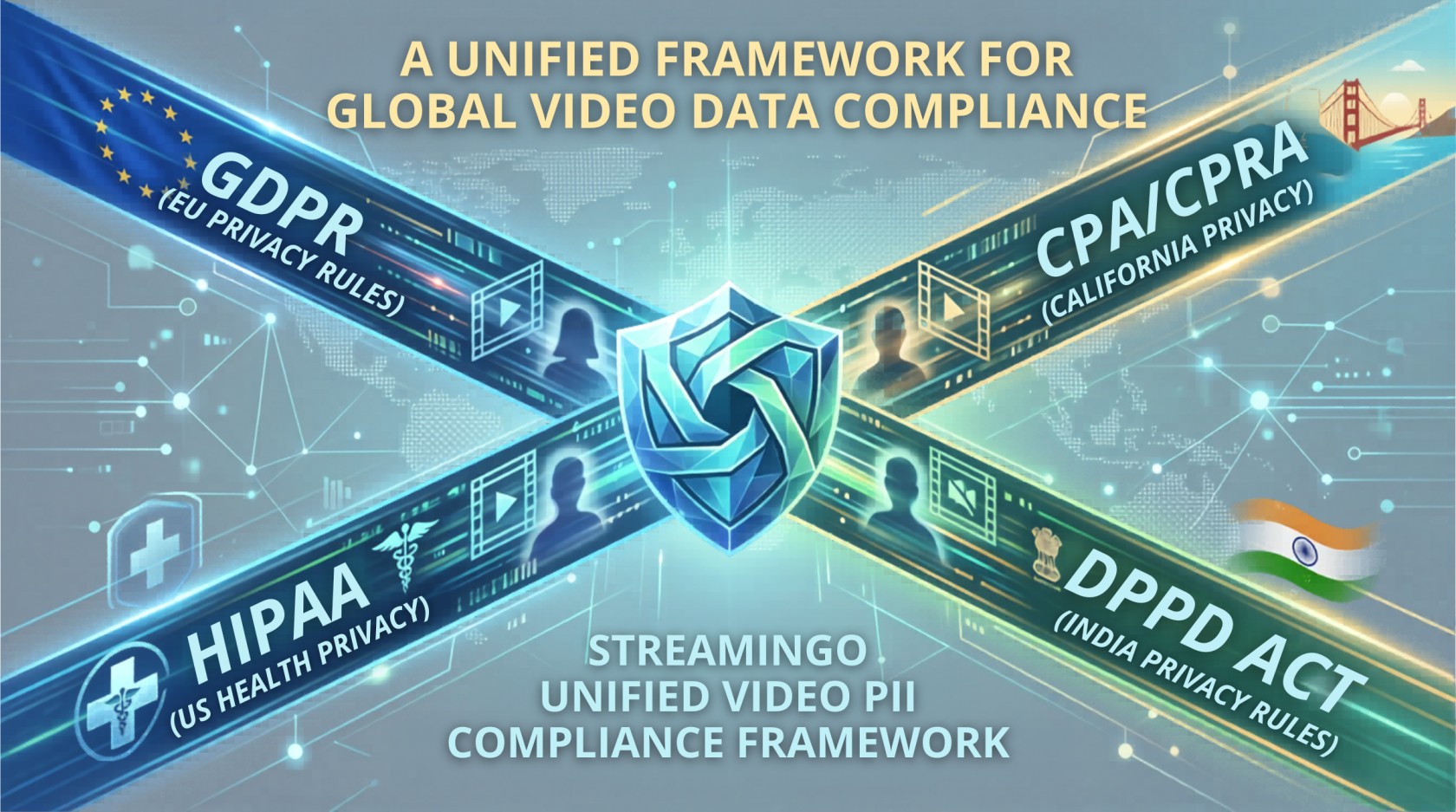
For global enterprises handling video data — whether consumer focus groups, remote clinical trials, or B2B meeting recordings — the compliance landscape has reached a point of critical friction. Operating separate data pipelines for the EU, US, and India is structurally inefficient and cost-prohibitive. The answer lies in unified, structural de-identification at ingestion.
Raw video natively captures high-fidelity Personally Identifiable Information (PII) and biometric data. To utilize this data for behavioral analytics, UX research, or AI training without triggering multi-million dollar cross-border liabilities, organizations must move from reactive legal posturing to proactive, built-in data architecture.
The Multi-Jurisdictional Video Compliance Matrix#
Each regulatory framework treats video footage with varying degrees of severity, but they all converge on a single principle: if the individual is unidentifiable, the regulatory burden drops exponentially. Understanding how each regulation treats anonymized video is the foundation of a scalable compliance strategy.
| Regulation | Video Data Category | Core Mandate | Impact of True Anonymization |
|---|---|---|---|
| GDPR EU / EEA |
Biometric & Personal Data (Art. 4) | Enforces Data Minimization (Art. 5) and the right to erasure across all member states. | Completely removes video data from GDPR scope once irreversibly de-identified. |
| HIPAA United States |
Protected Health Information (PHI) | Safe Harbor Method mandates removal of full-face photographic images and comparable biometric identifiers. | Renders health-related video interviews fully compliant and globally shareable. |
| CCPA/CPRA California, US |
Sensitive Personal Information (SPI) | Mandates the right to restrict processing, opt-out of sharing, and delete personal data on demand. | De-identified data is excluded from the legal definition of "personal information." |
| DPDP Act India |
Digital Personal Data | Requires Data Fiduciaries to enforce purpose limitation, strict retention ceilings, and parental consent for minors. | Anonymized data bypasses Data Principal obligations and cross-border transfer restrictions. |
The Architectural Pitfall: Infrastructure Duplication#
Historically, enterprises attempted to solve cross-jurisdictional compliance by creating geographic or compliance-specific silos — a pipeline for HIPAA-cleared health videos, another for GDPR-compliant consumer insights, and yet another for DPDP-governed storage in India.
Every raw video file stored across multiple regional pipelines acts as a honeypot for cyber threats, exponentially increasing your biometric data liability surface across all four jurisdictions simultaneously.
This siloed approach introduces three severe operational vulnerabilities:
-
Data Swamps Redundant copies of raw video files across multiple cloud regions inflate storage costs and create redundant compliance exposure — multiplying the breach liability surface without adding any analytical value.
-
Escalated Breach Targets Every isolated raw biometric video file becomes a discrete attack vector. A single breach now triggers simultaneous notification obligations under GDPR, HIPAA, CCPA, and DPDP — a four-regulator crisis.
-
Analysis Bottlenecks Data science and research teams spend disproportionate time verifying access governance across silos rather than extracting the actionable behavioral insights the data was collected for in the first place.
To scale effectively, enterprises require a Unified Compliance Layer embedded at the ingestion point — not bolted on downstream as an afterthought.
Streamingo's Resolution: Automated Zero-Trust Video Ingestion#
Streamingo resolves this cross-jurisdictional bottleneck by embedding automated, high-precision anonymization directly into the data lifecycle via its enterprise platform and REST APIs. Instead of defending the data after storage, Streamingo alters the data's biometric identity at the moment of ingestion.
Zero-PII via In-Pipeline Blurring
Automated face and audio blurring strips full-face graphics and unique vocal prints before video hits long-term storage — satisfying GDPR Privacy by Design, HIPAA Safe Harbor, CCPA exclusion criteria, and DPDP minimization in a single pass.
Behavioral Utility with Precision Anonymization
Advanced spatiotemporal deep learning isolates and tracks human actions, objects, and environmental contexts at up to 98% accuracy — keeping the behavioral signal while eliminating the biometric footprint entirely.
Seamless Compliance Auditing
Immutable processing logs and verifiable anonymization pipelines create a transparent audit trail for DPOs, proving under GDPR Article 5 and DPDP Rules that biometric PII was scrubbed at the perimeter, not manually downstream.
Streamingo's spatiotemporal models maintain frame-consistent anonymization across long-form recordings — preventing identity re-linking from temporal patterns even when individual frames appear blurred in isolation.
The Operational Trifecta: Future-Proofing Enterprise Video Data#
In the global enterprise ecosystem, compliance cannot be an afterthought managed by manual video-editing teams. By deploying Streamingo's automated anonymization infrastructure at ingestion, organizations achieve a rare operational outcome across all four dimensions simultaneously.
By neutralizing the identity at the point of ingestion, you don't just satisfy regulators — you unlock the full global utility of your video data assets. The compliance cost center becomes a strategic enabler.
Frequently Asked Questions#
Does video anonymization satisfy both GDPR and HIPAA simultaneously?
Yes. Irreversible facial and audio anonymization satisfies GDPR's Privacy by Design (Art. 25) and Data Minimization (Art. 5), and simultaneously meets HIPAA's Safe Harbor de-identification threshold by removing full-face photographic images and biometric identifiers — fulfilling both frameworks in a single processing pass.
How does India's DPDP Act affect video data stored outside India?
India's DPDP Act requires Data Fiduciaries to impose purpose limitation, strict retention ceilings, and cross-border transfer restrictions on personal data. Once video is irreversibly anonymized, it no longer qualifies as "digital personal data," bypassing all Data Principal obligations and cross-border restrictions entirely.
What qualifies as de-identified data under CCPA/CPRA?
Under CCPA/CPRA, data is considered de-identified when it cannot reasonably be used to infer information about or be linked to a specific consumer. Properly anonymized video footage with facial and audio identifiers removed — and with technical safeguards preventing re-identification — is excluded from the definition of "personal information" under California law.