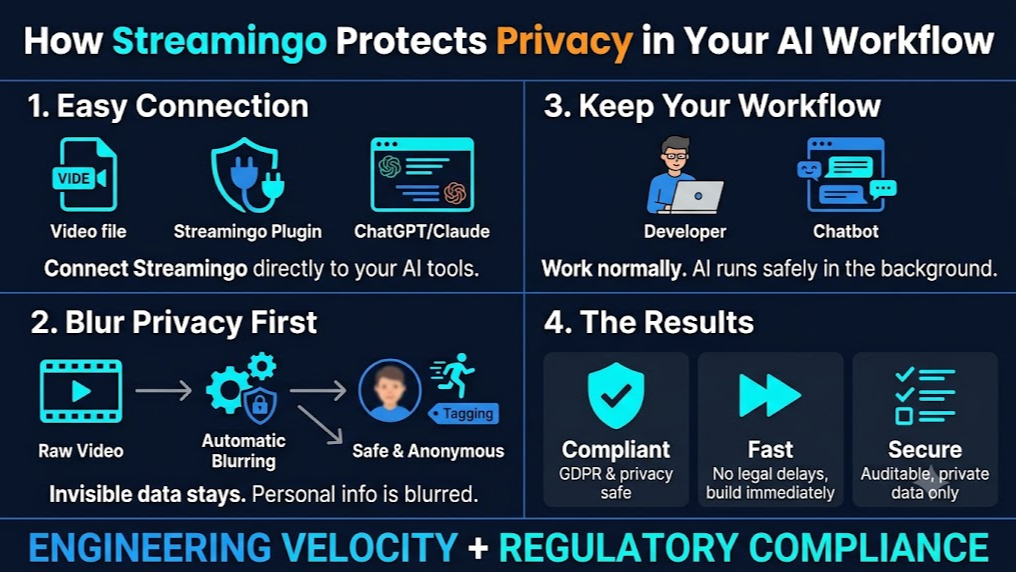
Modern AI coding assistants like Claude Code and ChatGPT have transformed how engineering teams build software. Developers can now scaffold pipelines, test computer vision models, and automate video workflows in a fraction of the time.
However, feeding real-world video into AI pipelines introduces a major legal and security bottleneck: raw video is loaded with personally identifiable information (PII). Streaming unredacted footage through external APIs, or using it in model training, can put your organization in violation of GDPR, CCPA, and enterprise privacy mandates.
By integrating Streamingo's Video Redaction plugin into your Claude and ChatGPT workflows, you can solve this privacy paradox. Here is how to build a compliant, production-grade video AI pipeline without changing how your team writes code.
1. Integrate the Streamingo Redaction Plugin into Claude Code and ChatGPT#
Rather than treating PII protection as a disconnected offline chore, connect Streamingo directly into your AI development environment through its plugin or API integration.
2. Anonymize Before Training#
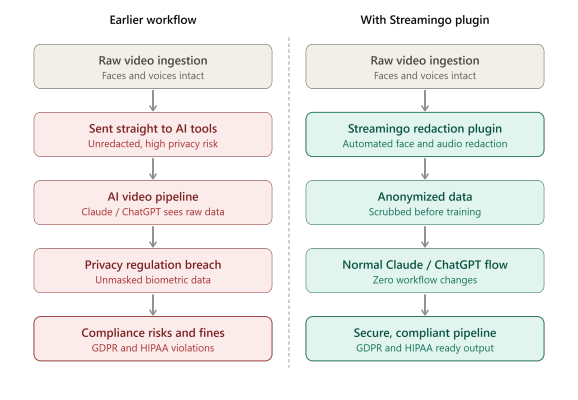
The golden rule of compliant AI engineering is simple: no unredacted footage should ever enter the training or inference loop.
With Streamingo in your pipeline, every video asset passes through automated redaction before dataset curation begins:
- Identity neutralization: PII is automatically detected and masked across every frame.
- Preserved kinematics: Streamingo removes identity while preserving contextual visual information such as human posture, motion vectors, spatial interactions, and scene geometry.
- Integrated annotation: clean, anonymized videos and images can go straight to computer vision tasks such as action recognition, queue detection, or safety compliance.
Because PII is removed at the ingestion boundary, your training datasets are cleared of biometric risk before any model sees them.
| Concern | Raw video into the pipeline | Redacted at ingestion with Streamingo |
|---|---|---|
| PII exposure | Faces and bodies reach external APIs and training data | Identity masked across every frame before anything leaves |
| Biometric risk in datasets | Present in training data | Removed before any model sees the data |
| Usefulness for CV | Full detail, full risk | Posture, motion vectors, spatial interactions, and scene geometry preserved |
| Compliance review | Can stall projects for months | Pre-redacted streams let teams build and test sooner |
| Audit evidence | Hard to prove what was purged | Each asset carries an auditable trail |
3. Maintain Your Normal Claude / ChatGPT Software Workflow#
The main advantage of this architecture is zero developer friction. You don't need to rewrite your tech stack or adopt a clunky, isolated privacy dashboard. Your day-to-day workflow inside Claude and ChatGPT stays unchanged.
Streamingo works in the background, handling automated anonymization while your team keeps building inside the AI tools it already relies on.
4. The Outcome: Secure, GDPR-Compliant, and Production-Ready#
Building your video AI pipeline around Streamingo and Claude/ChatGPT delivers three business advantages:
Follows "Privacy by Design" (GDPR Art. 25). Raw biometric data is never sent to third-party LLM providers, reducing exposure to serious compliance penalties.
Compliance reviews and legal sign-offs often stall AI initiatives for months. Pre-redacted data streams let data science teams build, train, and test right away.
Every redacted asset carries an auditable trail proving PII was systematically purged before downstream AI models used it.
By placing Streamingo's automated redaction at the front gate of your Claude and ChatGPT workflows, you remove the tradeoff between engineering velocity and regulatory compliance. You keep the speed and reasoning power of modern AI assistants, with confidence that your video data stays private and secure.
Redaction is a strong technical safeguard, but GDPR compliance depends on your organization's overall data processing. Review your setup with your legal and privacy teams.
Get the Streamingo Video Redaction Plugins#
Add automated video redaction to the AI assistant your team already uses.
Glossary of Key Terms#
- Personally Identifiable Information (PII)
- Information that can identify a person; in video, chiefly faces and bodies, which are present in raw footage.
- Video Redaction (Video Anonymization)
- Automatic detection and masking of PII across every frame of a video so identities are neutralized while the scene remains usable for analysis.
- Privacy by Design (GDPR Article 25)
- The GDPR principle of building data protection into systems by design and by default, rather than adding it afterward.
- Preserved Kinematics
- Retaining non-identifying visual information, such as human posture, motion vectors, spatial interactions, and scene geometry, after redaction so computer vision tasks still work.
- Ingestion Boundary
- The point where raw video first enters a pipeline; redacting here ensures downstream training and inference only ever see anonymized data.
- Biometric Data
- Personal data derived from physical characteristics, such as facial features, that can uniquely identify an individual and carries heightened regulatory risk.
- Audit Trail
- A verifiable record showing that PII was systematically purged from an asset before it was used by downstream AI models.
Frequently Asked Questions#
Why is it risky to feed raw video into AI pipelines and LLM APIs?
Raw video contains PII such as faces and bodies. Sending unredacted footage to external APIs or using it for training can violate GDPR, CCPA, and enterprise privacy mandates, and creates legal and security bottlenecks.
What is video redaction (video anonymization)?
Automatic detection and masking of PII across every frame, neutralizing identity while preserving usable context like posture, motion vectors, spatial interactions, and scene geometry.
How does Streamingo's Video Redaction plugin work with Claude and ChatGPT?
It connects to your AI development environment through a plugin or API integration. Video is redacted automatically before it enters the pipeline, while your team keeps its normal coding workflow.
What does "anonymize before training" mean?
No unredacted footage enters the training or inference loop. Every asset is redacted before dataset curation, so PII is removed at the ingestion boundary and training data is cleared of biometric risk.
Can computer vision still work on redacted video?
Yes. Posture, motion vectors, spatial interactions, and scene geometry are preserved, so anonymized video works for action recognition, queue detection, and safety compliance.
How does redacting video support GDPR Article 25 (privacy by design)?
Redacting PII at the front of the pipeline builds privacy into the architecture, so raw biometric data never reaches third-party LLM providers. Review your overall processing with legal and privacy teams.
How does pre-redacted video remove data bottlenecks for AI teams?
Compliance reviews can stall AI projects for months. Pre-redacted streams let teams build, train, and test sooner, and each asset carries an auditable trail of PII removal.
Where can I get the Streamingo Video Redaction plugins?
Both the Claude and ChatGPT plugins are linked in the "Get the Streamingo Video Redaction Plugins" section above.