
SaaS product managers constantly weigh building versus integrating specialized features. When it comes to video data privacy, software leaders must decide whether in-house engineering or external integration is the more viable path.
Many teams assume that building redaction in-house is the safer, cheaper route. That assumption is usually a costly mistake.
For the vast majority of software products, training custom object detection models is the wrong place to allocate engineering headcount. Rather than developing video redaction in-house, engineering teams should integrate off-the-shelf engines, particularly when they need to meet enterprise-grade privacy standards. Reliable, scalable detection involves surprising complexity that can quickly become a full-time research initiative for SaaS companies entering computer vision for the first time.
The Build vs. Buy Delusion: Why Custom CV Models Sink Roadmaps#
A production-ready computer vision pipeline takes far more than training a basic model on a few thousand images. To handle real-world video, your model must consistently detect targets across:
- Variable lighting conditions and extreme shadows
- Multiple camera angles, lens distortions, and focal lengths
- Low-resolution, grainy security footage or compressed web streams
- Continuous edge-case tracking as data drift occurs over time
Maintaining this pipeline requires a dedicated evaluation harness, continuous dataset labeling, and an ongoing retraining pipeline. That is a multi-quarter research program before your application processes a single enterprise-scale video workload.
When Does Building Actually Make Sense?#
Building an in-house model is defensible only under three narrow conditions:
You need to redact hyper-specific targets that no commercial engine supports, such as proprietary industrial schematics or custom hardware interfaces.
You already employ a dedicated computer vision engineering team with existing pipeline infrastructure.
Video redaction is your core product differentiator, not an enabling feature.
If your product isn't defined by custom computer vision research, your engineering resources are better spent on seamless review workflows, robust access controls, and superior customer experiences.
The 3 Integration Patterns for Video Redaction#
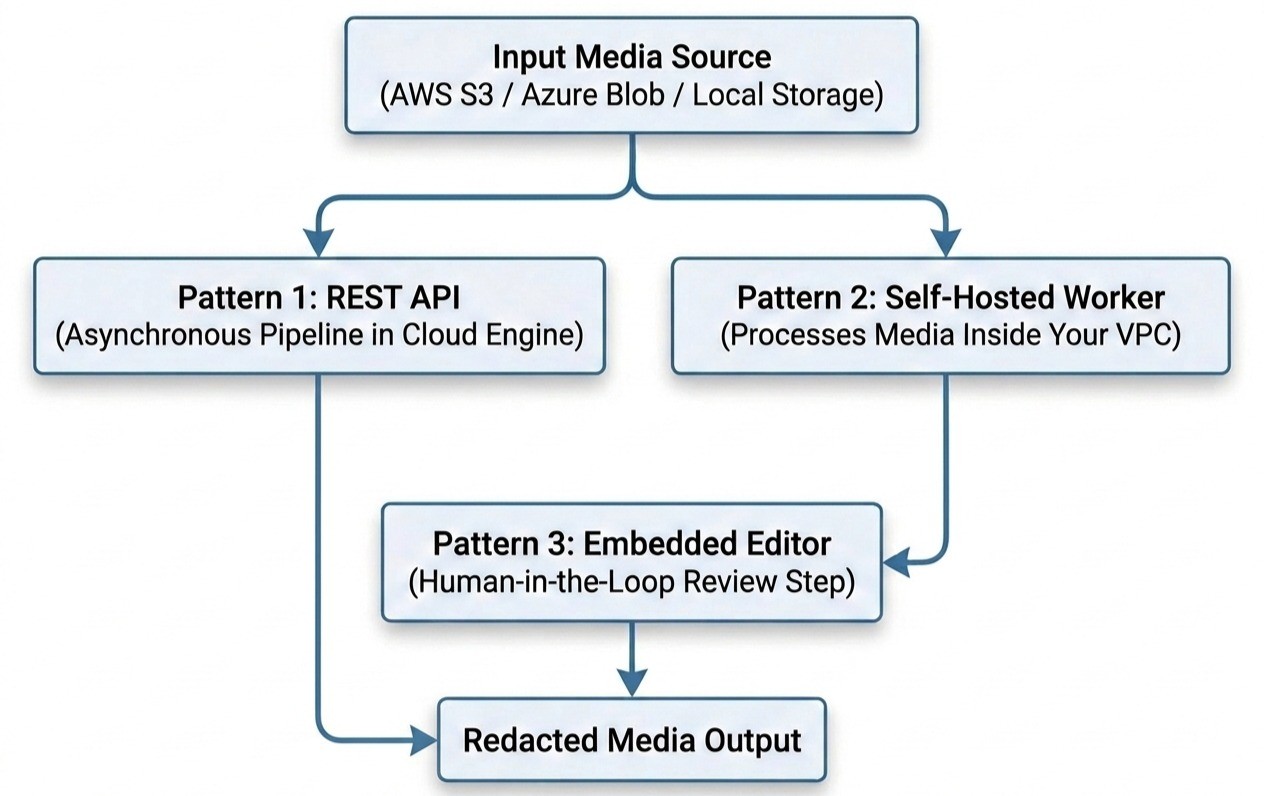
When embedding pre-trained redaction into a SaaS architecture, you don't need to reinvent the delivery mechanism. Three primary patterns cover virtually every technical and business requirement.
Build or buy: choosing the video redaction path that keeps your roadmap on track.
Pattern 1: The Asynchronous REST API
This pattern fits background processing where files move programmatically through your system without immediate manual intervention.
- How it works
- Your backend issues an asynchronous POST request to an endpoint such as
/videos:process. The payload includes input media URIs, target detection features (for example, faces), and an output destination. - Infrastructure fit
- Input and output URIs connect directly to your existing cloud storage, such as AWS S3 buckets or Azure Blob Storage. Completion is tracked through webhook notifications or standard polling.
- Best for
- Automated ingest pipelines, bulk archiving, and high-volume background processing where scalability is the main goal.
Pattern 2: The Self-Hosted Redaction Worker (On-Premise)
For enterprise SaaS vendors, "our media cannot leave our security boundary" is a common roadblock that halts sales cycles in regulated industries. The self-hosted worker solves this by running the detection engine inside your own virtual private cloud (VPC) or local infrastructure.
- How it works
- The pre-trained engine is deployed as a containerized worker within your network. Media files are pulled, processed, and written to local storage without a single frame crossing external network boundaries.
- Key advantage
- It keeps media inside your security boundary and supports strict data sovereignty, making it the strongest pattern for winning deals in justice, healthcare, finance, defense, and public safety.
Pattern 3: The Embedded Editor (Human-in-the-Loop)
Automated detection excels at finding targets, but high-stakes workflows such as law enforcement evidence disclosure or legal discovery demand zero margin for error.
- How it works
- The detection engine does the heavy lifting by auto-generating bounding box coordinates and timestamps. These are served to an embedded front-end video editor where a human operator verifies, adjusts, or adds redaction masks before the final file is rendered.
- Key advantage
- Combining AI detection with human oversight gives a defensible, audit-ready redaction process and can cut manual editing time by up to 80%.
Decision Matrix: Matching Architecture to Constraints#
Choosing the right pattern depends on weighing your dominant architectural constraint against your product requirements:
| Dominant constraint | Best-fit pattern | Why | Typical use |
|---|---|---|---|
| Scale and throughput | Asynchronous REST API | Works with your existing cloud storage; tracked by webhooks or polling | Automated ingest, bulk archiving, high-volume background jobs |
| Data sovereignty and security boundary | Self-hosted redaction worker | Engine runs in your VPC or local infrastructure; no frame leaves your network | Justice, healthcare, finance, defense, public safety |
| Zero margin for error | Embedded editor (human-in-the-loop) | Humans verify and adjust AI-generated masks before rendering | Evidence disclosure, legal discovery |
| Niche targets, existing CV team, or redaction as your core product | Build in-house | No commercial engine covers it, or it is your differentiator | Proprietary schematics, custom hardware interfaces |
These patterns can be combined. For example, a self-hosted worker can feed an embedded editor for regulated, high-stakes review.
How Streamingo Anonymize Helps You Redact#
If you want to add enterprise-grade video redaction to your product without spending quarters building machine learning models, Streamingo Anonymize is an off-the-shelf solution designed for developer integration. It speeds up time to market while handling the heavy lifting of computer vision, data privacy, and compliance:
Over 98% detection accuracy for faces, license plates, full-body identities, and sensitive audio, without labeling a single video frame.
Integrate quickly with low-latency REST APIs for automated background workflows, or deploy as a self-hosted edge or cloud worker to enforce zero data retention and strict data sovereignty in your own environment.
Interactive tools let your end users review, adjust, or refine AI-generated bounding boxes before final release.
Cut operational redaction costs by 60–70% while supporting GDPR, CCPA, HIPAA, and DPDP requirements with verifiable, audit-ready logs.
By partnering with Streamingo Anonymize, your team avoids the multi-quarter ML development trap and focuses engineering effort on features that grow your business.
Redaction supports privacy compliance, but meeting GDPR, CCPA, HIPAA, or DPDP obligations depends on how your organization deploys and governs the tooling. Validate your setup with legal and privacy advisors.
Add Video Redaction Without the ML Detour
See how Streamingo Anonymize fits your architecture, whether that's a REST API, a self-hosted worker, or an embedded review editor.
Explore Streamingo AnonymizeGlossary of Key Terms#
- Video Redaction
- Automatically or manually masking sensitive information, such as faces, license plates, bodies, and audio, in video so it can be shared or processed safely.
- Human-in-the-Loop (HITL)
- A workflow in which AI generates detections and a human operator reviews, adjusts, or adds masks before final output.
- Self-Hosted (On-Premise) Redaction Worker
- A containerized redaction engine deployed inside a customer's own VPC or local infrastructure so media never crosses external network boundaries.
- Data Sovereignty
- The requirement that data stays within a specified security boundary or jurisdiction and under the owner's control.
- Bounding Box
- Coordinates, usually with timestamps, that mark where a detected target such as a face appears in a video frame.
- Evaluation Harness
- The test infrastructure used to measure a computer vision model's accuracy across varied conditions before and after retraining.
- Data Drift
- Gradual change in real-world input data over time that degrades a model's accuracy unless it is continuously monitored and retrained.
- DPDP
- India's Digital Personal Data Protection Act, a data privacy law that applies to organizations processing personal data of individuals in India.
Frequently Asked Questions#
Should a SaaS company build or buy video redaction?
For most products, buy. Custom detection models can become a multi-quarter research program, and engineering time is better spent on review workflows, access controls, and customer experience.
When does building video redaction in-house make sense?
Only when you need niche classes no engine supports, already have a dedicated CV team and infrastructure, or redaction is your core product differentiator.
Why is building a video redaction pipeline so hard?
Models must handle variable lighting, camera angles, lens distortion, low-resolution or compressed footage, and data drift, which demands an evaluation harness, continuous labeling, and retraining.
What are the three integration patterns for video redaction?
An asynchronous REST API for scale, a self-hosted worker for data sovereignty, and an embedded human-in-the-loop editor for zero-error workflows.
When should I use a self-hosted video redaction worker?
When regulated customers in justice, healthcare, finance, defense, or public safety require that media never leave their security boundary.
What is human-in-the-loop video redaction and when is it needed?
AI proposes bounding boxes and timestamps; a person verifies and adjusts them before rendering. It's needed for evidence disclosure and legal discovery, and can cut manual editing time by up to 80%.
What does Streamingo Anonymize offer for video redaction?
Pre-trained detection of faces, license plates, bodies, and sensitive audio (98%+ accuracy per Streamingo), REST and self-hosted deployment, human-in-the-loop tools, and audit-ready logs.
Which privacy regulations does automated video redaction help with?
It's designed to support GDPR, CCPA, HIPAA, and DPDP compliance through audit-ready logs. Compliance still depends on your deployment and governance, so confirm with legal advisors.