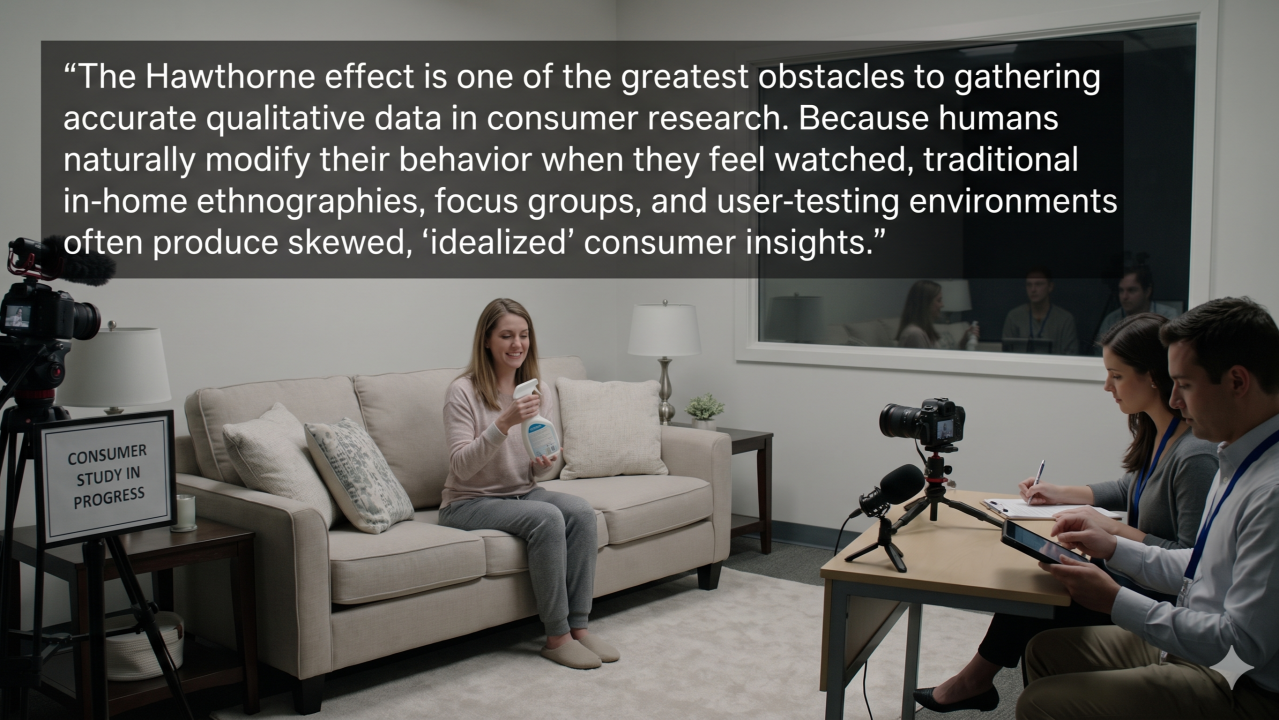
The Hawthorne effect is one of the greatest obstacles to gathering accurate qualitative data in consumer research. Because humans naturally modify their behavior when they feel watched, traditional in-home ethnographies, focus groups, and user-testing environments often produce skewed, "idealized" consumer insights.
By leveraging its proprietary spatio-temporal inference engine, FizzStream, Streamingo tackles this fundamental behavioral bias. It moves kitchen action observation from highly apparent, disruptive monitoring to passive, continuous, and contextual data analytics.
The Deep Impact of the Hawthorne Effect on Consumer Research#
When consumers realize they are part of a study, their true habits are obscured by social desirability bias and performative adaptation:
- The "Clean House" Distortion: in a traditional study assessing laundry or kitchen products, a participant will clean their space before a researcher arrives, hiding the chaotic reality and the actual pain points of product usage.
- Artificial Attentiveness: if a user knows their interaction with an appliance is being recorded, they operate with a heightened level of focus that doesn't mirror their multi-tasking, distracted daily reality.
- The Chronological Bottleneck: the Hawthorne effect is strongest during the initial hours of an observation, but human research teams lack the budget and stamina to film and manually log weeks of raw footage just to wait for the participant to act naturally.
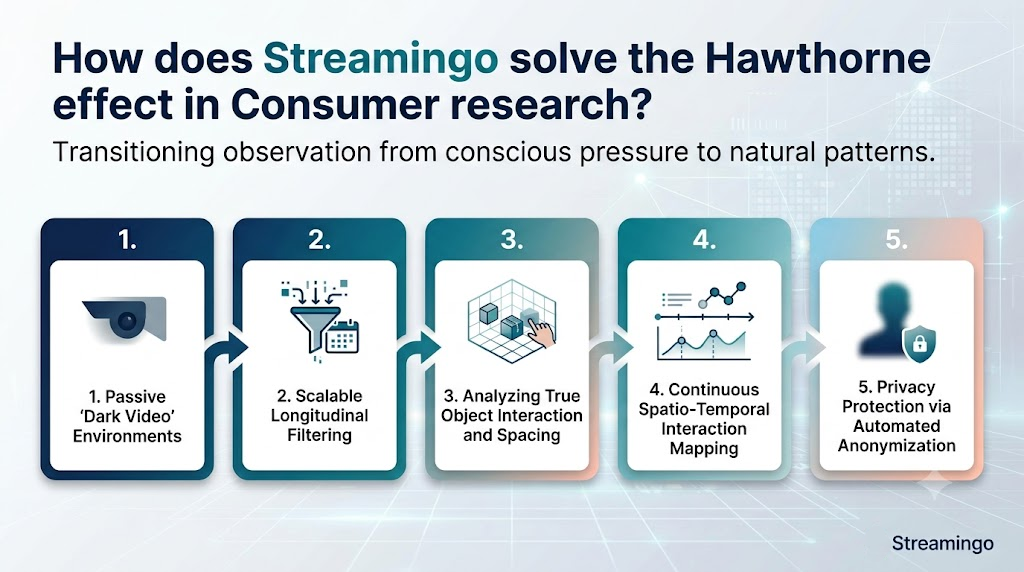
How Streamingo's Spatio-Temporal Inference Solves It#
The seconds before the spray bottle: where real product friction hides.
Spatio-temporal analysis evaluates video frames not as isolated, static 2D pixels, but as actions flowing across continuous space (spatial) and time (temporal). Streamingo applies this at scale, undermining the Hawthorne effect through four core mechanisms.
1. Transitioning to Passive "Dark Video" Environments
Instead of deploying intrusive researchers or highly conspicuous recording devices, Streamingo ingests video directly from existing camera infrastructures or simple passive setups within natural environments. With non-participatory observation over long time intervals, the camera effectively "blends into the background," letting the performative Hawthorne effect decay as consumers revert to their genuine, messy routines.
2. Scalable Longitudinal Filtering
Because Streamingo processes hundreds of hours of raw video in a fraction of the time, consumer packaged goods (CPG) innovators and insights teams can run long-term observational studies. Researchers can systematically exclude the first 24–48 hours of video, where the Hawthorne effect is most active, and direct the AI to analyze only the following weeks of baseline, unvarnished behavior.
3. Continuous Spatio-Temporal Interaction Mapping
Streamingo tracks fine-grained human activity, continuous movement patterns, and physical interactions across two core dimensions:
Analyzes interactions such as package grip, cap torque, or movement through store aisle layouts, evaluating exactly how a user handles the product.
Measures exact dwell times, momentary hesitations, and periods of distraction, clocking authentic behavior rather than reported behavior.
By objectively capturing these multi-dimensional micro-behaviors, the AI identifies minor physical struggles and natural ergonomic adaptations that a performative participant would otherwise hide from a human interviewer.
4. Privacy Protection via Automated Anonymization
Self-consciousness about personal privacy significantly amplifies the Hawthorne effect. Streamingo addresses this with its integrated, GDPR-compliant Anonymize module, which protects personally identifiable information (PII) by automatically applying precise facial and full-body blurring at the edge or in the cloud. Reassured that their identities remain protected from human reviewers, participants act naturally, yielding uncompromised behavioral data.
| Distortion | Traditional research | Spatio-temporal AI approach |
|---|---|---|
| "Clean house" | Participant tidies before the researcher arrives | Passive dark video over weeks reveals the messy, real routine |
| Artificial attentiveness | Heightened focus while being watched | Early footage dropped; only baseline behavior analyzed |
| Time bottleneck | Manual logging of weeks of video is impractical | AI processes hundreds of hours in a fraction of the time |
| Privacy self-consciousness | Participants know humans can see them | Automatic face and full-body blurring protects PII |
Conclusion: Unlocking the Truth in Consumer Behavior#
The Hawthorne effect has long forced brands to make high-stakes decisions based on staged, performative consumer behavior. Streamingo's spatio-temporal inference engine, FizzStream, addresses this bias. By replacing intrusive monitoring with continuous, passive, and privacy-first AI analysis, Streamingo lets researchers bypass the performative guard and capture weeks of authentic, unvarnished human-product interaction at scale. Ultimately, this transforms unstructured video into precise spatial and temporal metrics, delivering the behavioral truth that brands need to innovate.
Want to see how FizzStream and Anonymize can capture unvarnished consumer behavior for your category? Talk to Streamingo.
Glossary of Key Terms#
- Hawthorne Effect
- The tendency of people to change their behavior when they know they are being observed, which skews ethnographies, focus groups, and user tests.
- Social Desirability Bias
- The tendency of research participants to act or answer in ways they believe will be viewed favorably, rather than in line with their real habits.
- Spatio-Temporal Inference
- Video analysis that evaluates actions across continuous space and time rather than as isolated 2D frames, enabling measurement of interactions, dwell times, and hesitations.
- FizzStream
- Streamingo's proprietary spatio-temporal inference engine that converts unstructured video into precise spatial and temporal behavioral metrics.
- Dark Video Observation
- Passive, non-participatory observation using existing or simple camera setups so recording blends into the background and participants revert to natural routines.
- Longitudinal Filtering
- Analyzing long-duration video while excluding the initial hours, when observer effects are strongest, and focusing on later weeks of baseline behavior.
- Dwell Time
- The exact duration a person spends on an interaction or in a location, measured temporally to reveal hesitation and distraction.
- Automated Anonymization
- Automatic facial and full-body blurring of video at the edge or in the cloud to protect personally identifiable information (PII) from human reviewers.
Frequently Asked Questions#
What is the Hawthorne effect in consumer research?
The tendency of people to modify their behavior when they know they're observed. It distorts ethnographies, focus groups, and user tests, producing idealized insights through social desirability bias and performative adaptation.
How does the Hawthorne effect distort consumer research results?
Through the "clean house" distortion, artificial attentiveness, and a chronological bottleneck that makes manually logging weeks of footage impractical.
What is spatio-temporal analysis in video AI?
Analysis of video as actions flowing across continuous space and time, not isolated frames. Spatially it tracks package grip, cap torque, and aisle movement; temporally it measures dwell times, hesitations, and distraction.
How does Streamingo reduce the Hawthorne effect?
With four mechanisms: passive dark video, longitudinal filtering, continuous spatio-temporal interaction mapping, and automated anonymization that blurs faces and bodies.
Why discard the first 24 to 48 hours of video in a consumer study?
The Hawthorne effect is strongest in the opening hours. Dropping them and analyzing the following weeks captures baseline behavior once participants have reverted to genuine routines.
How does video anonymization help reduce observer bias?
Privacy self-consciousness amplifies the Hawthorne effect. Automatic facial and full-body blurring, at the edge or in the cloud, protects PII from human reviewers so participants act more naturally.
What is FizzStream?
Streamingo's proprietary spatio-temporal inference engine, which turns unstructured video into precise spatial and temporal metrics through passive, privacy-first analysis.