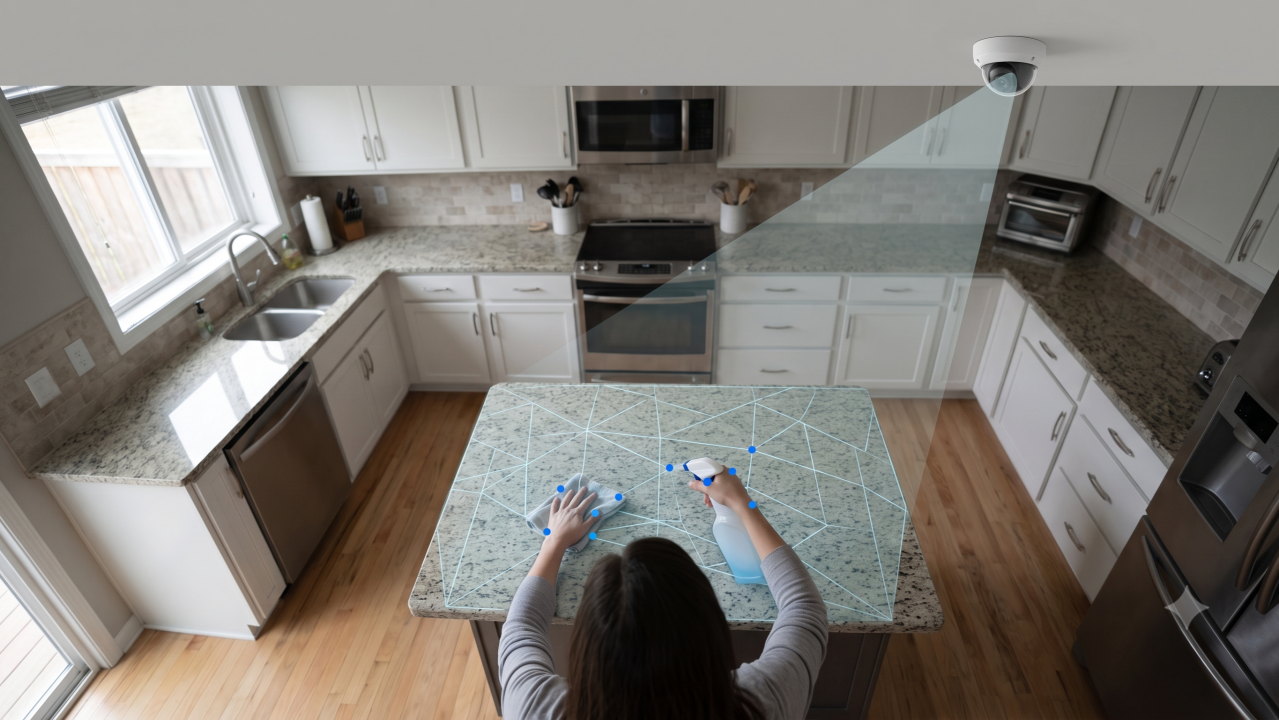
Consumer research in CPG exists to answer one question, asked in a hundred different forms: what do consumers actually do, and why?
The standard toolkit for this is well established, and together these methods have long been the backbone of consumer understanding. But there is one question the toolkit consistently struggles to answer: how are consumers actually using our products, and what can we do to improve sales for the product line?
The Standard Toolkit and Where It Runs Out#
| Method | What it captures | What it can't show |
|---|---|---|
| Surveys | What people say they think | What they actually do in the moment |
| Questionnaires | Attitudes, quantified at scale | The mechanics of physical behavior |
| Focus groups | Reactions, body language, real-time follow-ups | Real usage; the setting is stated or staged rather than natural |
| POS data | What's selling, where, and when | What happened after the product left the shelf |
The gap isn't a lack of effort. It's a structural limitation of self-reported data. And "how are consumers using this product" is precisely a duration, sequence, and frequency question: how long someone scrubs, in what order they pour, scrub, and rinse, and how many times they repeat a step. Surveys and focus groups are built to capture stated attitudes and recollections, not the raw mechanics of behavior at the moment it happens. POS data closes the loop even further out. It confirms a purchase happened, but says nothing about what came after.
The Evidence: Self-Reports Diverge from Reality#
- Brand usage behavior: a widely cited study found that self-reports diverge from actual usage most among light or infrequent users, who tend to forget an occasion of use entirely, or answer to match how often they think they should use a product.
- Food-handling behavior: a separate observational study comparing self-reported and actual behavior across 900 consumers found that observed practices were significantly worse than what respondents reported about themselves, a gap that shows up consistently across categories.
The stakes of getting this wrong are not small:
A large share of that failure is attributed not to product quality but to misread consumer needs. Brands built the right product for the wrong understanding of how it would actually be used.
The Only Reliable Way to Close the Gap: Direct Observation#
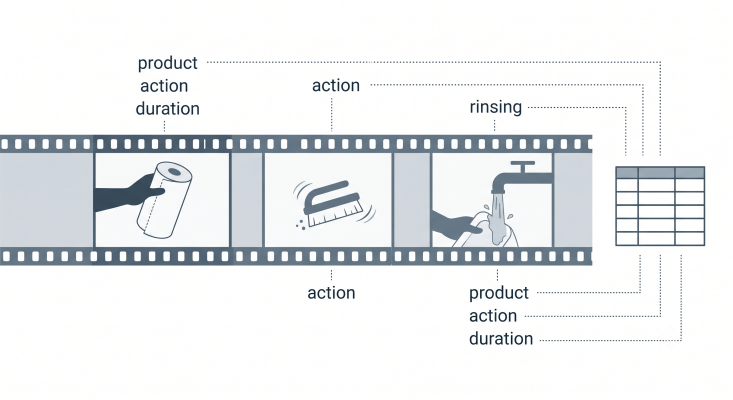
One method captures actual behavior rather than reported behavior: recording video of consumers using the product and reviewing the footage directly.
It brings a different problem. Watching footage isn't the hard part; tagging it precisely is. Answering the real research question means structuring the footage into three data points:
How long each activity lasted.
The order in which activities occurred.
The number of times each activity was repeated.
Done manually, this means reviewing hours of footage session by session and timestamping actions by hand. It is the only method that produces ground truth, and it is also why most teams that try it once never scale it to a full study or product line. Manual tagging effort grows linearly with every hour of footage collected, and tagging accuracy declines as the hours pile up and human fatigue sets in.
Where Streamingo Closes the Gap#
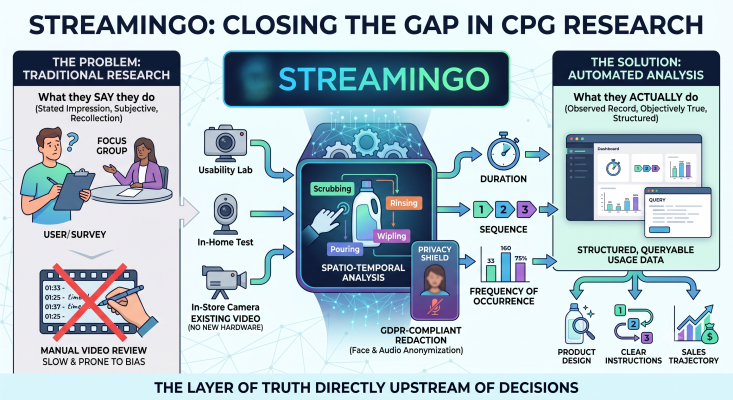
This is the specific problem Streamingo is built to solve. The platform takes existing video from usability labs, in-home tests, or in-store cameras, with no new hardware required, and automates the tagging step through spatio-temporal analysis. It identifies the product in frame, recognizes the activity being performed (scrubbing, rinsing, wiping, pouring), and structures the output into the three data points manual review would otherwise extract by hand: duration, sequence, and frequency of occurrence. Results are delivered through a dashboard or existing BI tools.
For CPG research, this converts product-use testing and in-store footage into structured, queryable usage data, instead of a stated impression from a survey or a recollection from a focus group.
On privacy, Streamingo includes GDPR-compliant video redaction with full face and audio anonymization, so behavioral data can be extracted and analyzed without retaining or exposing personal identity.
A research capability the standard toolkit was never designed to provide: not what consumers say they do with a product, but a structured, observed record of what they actually do. It is the layer of truth directly upstream of decisions about product design, instructions, and the product line's sales trajectory.
See What Your Consumers Actually Do
Talk to Streamingo about turning your existing product-use and in-store footage into structured usage data.
Talk to StreamingoGlossary of Key Terms#
- Self-Reported Data
- Information consumers provide about their own attitudes and behavior in surveys, questionnaires, and focus groups, which can diverge from what they actually do.
- Point-of-Sale (POS) Data
- Retail transaction data that confirms what sold, where, and when, but not how the product was used afterward.
- Direct Observation
- Recording and reviewing video of consumers using a product to capture actual rather than reported behavior.
- Ground Truth Behavior
- An observed, verifiable record of what consumers actually do, as opposed to what they say they do.
- Behavioral Tagging
- Structuring footage into labeled activities with timestamps, such as scrubbing, rinsing, wiping, or pouring.
- Duration, Sequence, and Frequency
- The three data points that describe product use: how long each activity lasts, the order in which activities occur, and how many times each is repeated.
- Spatio-Temporal Analysis
- Analysis of video across space and time to identify products, recognize activities, and measure when and for how long they occur.
- Video Redaction
- Masking personal identifiers in video, such as faces and audio, so behavior can be analyzed without exposing identity.
Frequently Asked Questions#
Why can't surveys and focus groups show how consumers actually use products?
They capture stated attitudes and recollections, not the duration, sequence, and frequency of physical behavior in the moment. POS data only confirms a purchase happened.
How much do self-reported and actual consumer behavior differ?
Self-reports diverge most among light or infrequent users, and an observational study of 900 consumers found actual food-handling practices were significantly worse than reported, a gap that recurs across categories.
What is the failure rate of new CPG products?
Industry estimates put it at 70–85% within two years, with Nielsen research suggesting only about 15% remain viable after 24 months. Much of the failure is attributed to misread consumer needs.
What is the most reliable way to capture actual consumer behavior?
Direct observation: recording video of consumers using the product and reviewing the footage.
Why don't most teams scale video-based consumer research?
Manual tagging is the bottleneck. Effort grows linearly with footage hours and accuracy declines with fatigue, so teams rarely extend it to a full study.
What three data points should usage video be structured into?
Duration of each activity, the sequence in which activities occurred, and the number of times each was repeated.
How does Streamingo automate video tagging for CPG research?
It uses spatio-temporal analysis on existing video, with no new hardware, to identify the product and recognize activities like scrubbing and rinsing, then outputs duration, sequence, and frequency to a dashboard or BI tools.
How does Streamingo protect privacy in consumer research video?
GDPR-compliant redaction with full face and audio anonymization lets behavior be analyzed without exposing identity.