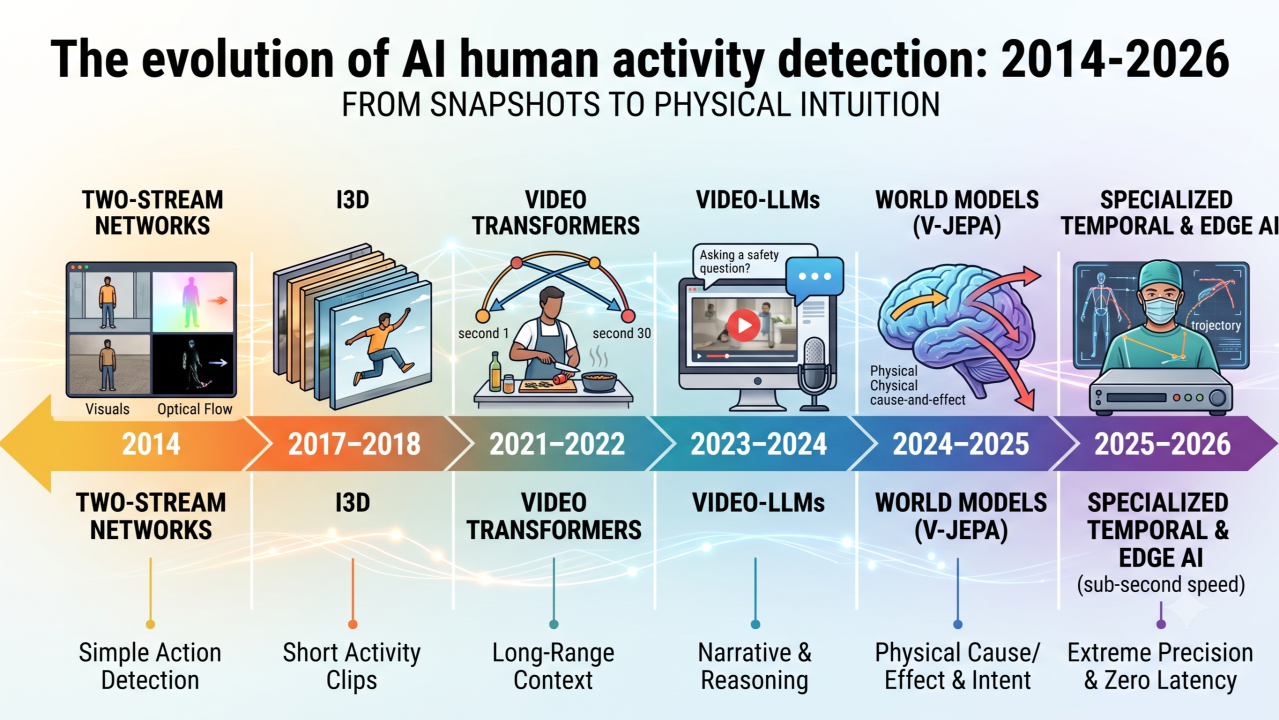
Over the last decade, AI architecture has undergone a massive transformation to solve the mystery of video understanding. Here is how video AI evolved from simple photo-analyzers into intelligent, real-time activity engines.
| Era | Architecture | Key Models | Core Limitation It Solved |
|---|---|---|---|
| 2014 | Two-Stream Networks | Two-Stream ConvNets | Static image models couldn't detect motion at all |
| 2017–2018 | 3D CNNs | C3D, I3D, SlowFast | Separate appearance/motion streams were slow and clunky |
| 2021–2022 | Video Transformers | TimeSformer, Video Swin | 3D CNNs had short memory and failed on longer activities |
| 2023–2024 | Video-LLMs | Video-LLaVA, LLaVA-NeXT | Transformers could label actions but not reason about them |
| 2024–2025 | Video World Models | Meta V-JEPA | Video-LLMs described video in text but lacked physical intuition |
| 2025–2026 | Edge-Native Spatio-Temporal Graphs | Temporal-First Event Architectures | World Models were too heavy for real-time, on-device deployment |
2014: The Two-Stream Era — Separating "Look" from "Motion"#
FoundationalEarly AI was built for single, static images. Fed a video, it couldn't tell whether a person was picking up a glass or putting it down — it only ever looked at individual snapshots.
Researchers created Two-Stream Networks. One AI stream analyzed static visual features — the person, the room, the glass — while a second stream calculated pixel movement frame-by-frame using Optical Flow.
Calculating optical flow frame-by-frame was incredibly slow, energy-hungry, and struggled with long, complex actions.
2017–2018: I3D Convolutional Networks — The Flipbook Approach#
UnificationProcessing static images and motion separately was clunky. AI needed a way to process space and time simultaneously.
3D CNNs — such as C3D, I3D, and SlowFast — were introduced. Instead of looking at 2D frames one by one, they stacked sequential frames into a 3D block, processing width, height, and time as a single volume.
Models could read short video clips like a flipbook, instantly grasping fluid actions like jumping or pouring a drink — without needing slow, pre-calculated motion tracks.
2021–2022: Video Vision Transformers — Connecting the Dots Across Time#
Long-Range Context3D CNNs had a short memory. They were great at recognizing a three-second action but failed at longer activities — like telling whether someone was cooking a meal versus just standing near a stove.
Inspired by language models, Video Transformers (TimeSformer, Video Swin) brought self-attention to video, providing a more flexible mechanism for connecting information across distant points in a clip. Attention models long-range relationships, but the actual temporal context a model can hold still depends on architecture, frame/token count, and sampling rate — all of which were comparatively limited in 2021–2022 versus today.
Models gained long-range memory, allowing AI to track multi-step human behaviors across extended clips.
2023–2024: Video-LLMs — Adding Speech and Context#
ReasoningVideo Transformers could label an action with a predefined word — "running" — but couldn't understand complex context, follow instructions, or explain why an action happened.
Developers combined Video Transformers with Large Language Models to create Video-LLMs (Video-LLaVA, LLaVA-NeXT). Users could now ask open-ended questions like, "Did the technician follow proper safety steps before starting the machine?" Action recognition became a problem of reasoning.
Video-LLMs were bloated, expensive to run, prone to hallucinating details, and lacked the micro-second frame precision required for high-stakes safety or medical tracking.
2024–2025: Video World Models — Understanding Physical Intuition & Cause/Effect#
Physical IntuitionVideo-LLMs were just describing what they saw using text, but lacked actual physical intuition. They didn't understand physics, cause-and-effect, or human intent.
World Models and Joint-Embedding Predictive Architectures — such as Meta's V-JEPA — were introduced. Instead of translating video into words or predicting raw pixels, World Models build an internal "mental simulator." By predicting how hidden visual features will change in the next split second, the AI learns physical constraints, trajectories, and object interactions naturally.
AI stopped just labeling actions and started anticipating human intent and physical behavior in dynamic environments.
2025–2026: Specialized Temporal-First & Edge Architectures#
Real-Time & Edge-NativeGeneral-purpose Video-LLMs and massive World Models proved too computationally heavy for real-world enterprise deployment. Real-time safety auditing, surgical tracking, and retail analytics required sub-second physical accuracy on low-power devices.
The industry shifted to Specialized Temporal-First Event Architectures and Spatio-Temporal Graph Models. By distilling the physical intuition of World Models into lightweight, edge-native networks, these models track human joint movements, micro-gestures, and spatial trajectories directly in real time.
Today's specialized video architectures deliver extreme precision — detecting subtle human activities at the edge with zero latency, low compute costs, and absolute privacy compliance.
The Takeaway#
In twelve years, video AI evolved from examining single photo snapshots to understanding complex, continuous human narrative. By moving from broad text approximations to physical world modeling and specialized spatial-temporal architectures, the field has finally gotten closer to giving machines the ability to understand human motion as fluidly as we do.
Video activity detection remains one of the most complex, unsolved challenges in Computer Vision. This article distills a decade of research and our own hands-on architectural experience at Streamingo into an accessible guide for non-technical readers. It's a bird's-eye view of how machines learned to understand human motion — and where the technology stands today as we continue working toward solving it.
Glossary of Key Terms#
- Two-Stream Network
- A 2014-era architecture combining a spatial (appearance) stream with a motion stream based on optical flow to recognize human actions in video.
- Optical Flow
- A frame-by-frame calculation of pixel movement between video frames, used to detect motion before 3D convolution became standard.
- I3D / 3D CNN
- A convolutional network (C3D, I3D, SlowFast) that treats width, height, and time as a single volume, reading a video clip the way a flipbook reads pages.
- Video Vision Transformer
- An architecture (TimeSformer, Video Swin) that applies self-attention to video, connecting information across more distant points in a clip than 3D CNNs could.
- Video-LLM
- A model (Video-LLaVA, LLaVA-NeXT) that combines a video transformer with a large language model, letting it answer open-ended questions about a clip rather than output a fixed label.
- Video World Model
- A Joint-Embedding Predictive Architecture (Meta's V-JEPA) that predicts how hidden visual features change moment to moment, learning physical constraints and cause-and-effect instead of describing video in words.
- Spatio-Temporal Graph Model
- A lightweight, edge-native architecture that represents human joints and movement as a graph over time, enabling real-time activity tracking on low-power devices.
Frequently Asked Questions#
What is a Two-Stream Network in video AI?
A Two-Stream Network splits video understanding into two parallel processes: one AI stream analyzes static visual features (the person, the objects, the scene), while a second stream calculates pixel-level movement frame-by-frame using optical flow. It let early models recognize simple actions, but the optical flow calculation was slow and energy-hungry.
Why did 3D CNNs like I3D replace Two-Stream Networks?
3D CNNs process width, height, and time as a single volume instead of handling appearance and motion separately. This "flipbook" approach let models read short clips directly and recognize fluid actions like jumping or pouring a drink without the slow, pre-calculated optical flow step.
What is a Video Vision Transformer and why was it needed?
Video Vision Transformers apply the self-attention mechanism from language models to video, connecting information across distant points in a clip. They were needed because 3D CNNs had a short effective memory and struggled with longer activities, such as telling cooking apart from just standing near a stove.
What makes Video-LLMs different from earlier action recognition models?
Video-LLMs combine video transformers with large language models so the system can reason about video instead of just labeling it — answering open-ended questions rather than returning a fixed word like "running." The trade-off is heavier compute, hallucination risk, and less frame-level precision.
What is a video world model, and how is V-JEPA different from a Video-LLM?
A video world model like Meta's V-JEPA predicts how hidden visual features change a fraction of a second into the future, building an internal simulation of physics, trajectories, and object interactions — rather than describing video in text the way a Video-LLM does.
Why are edge-native architectures replacing large world models for real-time use?
General-purpose Video-LLMs and large World Models are too computationally heavy for real-time, low-power deployment. Specialized Temporal-First and Spatio-Temporal Graph Models distill that physical intuition into lightweight, edge-native networks for sub-second accuracy at low compute cost.
What is the difference between action recognition and action understanding?
Action recognition means assigning a fixed label to what's seen in a video, such as "running" — the goal of Two-Stream Networks, 3D CNNs, and Video Transformers. Action understanding means reasoning about why an action happened and what it will cause, which is what Video-LLMs and video world models like V-JEPA aim to achieve.