Weekly Player Participation Statistics#
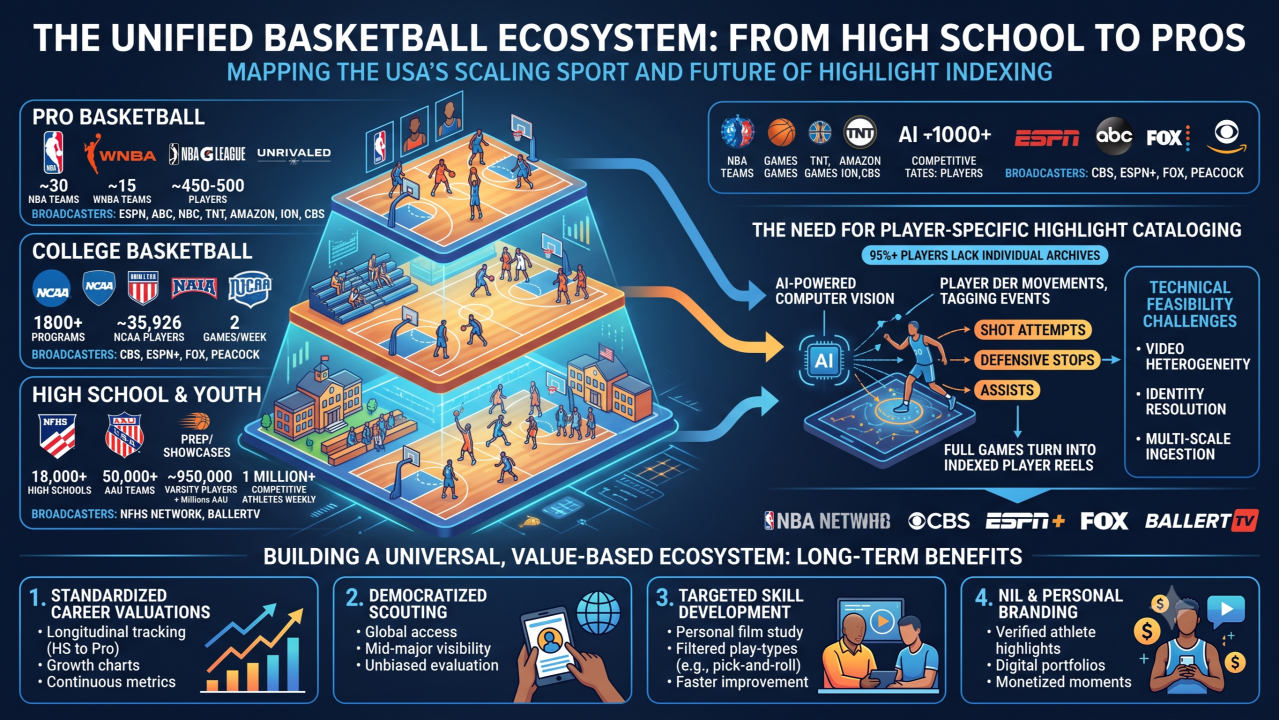
Basketball's scale in the United States is easy to underestimate until the numbers across every tier are laid side by side. From varsity gyms to NBA arenas, over a million athletes take the floor in organized competition every single week during peak overlapping season months.
At the professional tier, the pool narrows sharply: roughly 450–500 active NBA roster players, about 450 in the NBA G League, around 180 in the WNBA, and 30–36 in Unrivaled. Professional basketball, in other words, represents a tiny fraction of the athletes actually playing the sport competitively each week — the rest compete largely outside the spotlight of national media coverage.
League Broadcaster Identification#
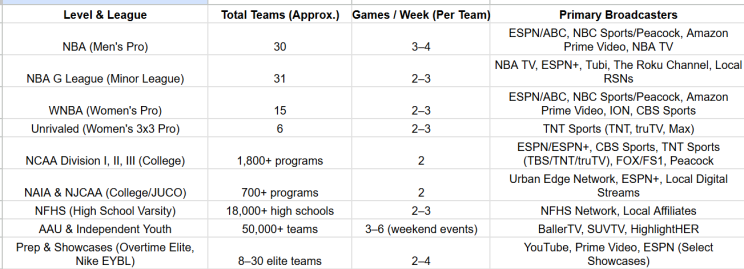
Media rights across American basketball are fragmented across dozens of national, regional, and streaming-only outlets — a structural reality that shapes exactly how much game film any given player is likely to have.
| League / Tier | Primary Broadcast & Streaming Partners |
|---|---|
| NBA | ESPN/ABC, NBC Sports/Peacock, Amazon Prime Video, NBA TV, plus Regional Sports Networks for local games |
| NBA G League | NBA TV, ESPN+, Tubi, The Roku Channel, and local team regional networks |
| WNBA | ESPN/ABC, NBC Sports/Peacock, Amazon Prime Video, ION Television, CBS Sports Network |
| Unrivaled | Multi-year exclusive coverage via TNT Sports (TNT, truTV, and Max) |
| NCAA (Div. I, II, III) | Div. I: ESPN networks, CBS/Paramount+, FOX/FS1, Peacock; March Madness split between CBS and TNT Sports. Div. II/III rely heavily on ESPN+ and institutional streaming apps |
| NAIA & NJCAA | Urban Edge Network, Continental Athletic Conference channels, and local webcasts |
| High School & Youth | NFHS Network holds central digital rights for state games; showcase circuits use BallerTV, YouTube, and select ESPN showcase slots |
The Need for Player-Specific Highlight Cataloging#
With hundreds of thousands of individual games played every week, media coverage naturally prioritizes top professional stars and elite Division I programs. Consequently, over 95% of active competitive basketball players lack an accessible, automated repository of their own game film.
Modern computer vision and AI camera technology solve this gap by isolating individual player tracking data — automatically indexing every play, shot attempt, defensive stop, and assist to generate indexed video profiles for every participant on the floor, not just the athletes broadcasters choose to feature.
Long-Term Benefits of Highlight Indexing#
Once every player — not just the ones on national television — has an indexed, searchable video record, the value compounds across the entire ecosystem.
Democratized Scouting
College recruiters and professional talent scouts can search and evaluate prospects across minor leagues and non-traditional media markets without requiring physical travel.
Accelerated Skill Development
Coaches and players access instant, tagged video clips categorized by play type — pick-and-roll efficiency, contested jump shots — to accelerate player evaluation and game adjustments.
NIL & Personal Branding
High school and college athletes gain automatically compiled, verified video highlights to showcase skills on social media and negotiate Name, Image, and Likeness deals.
Micro-Content Monetization
Broadcasters, sports platforms, and event directors can offer subscription-based, personalized highlight feeds directly to family members, fans, and scouting services.
Building a Unified Multi-League Data Standard#
Building a unified indexing system across high school, college, and professional basketball is a massive technical challenge — fragmented media rights, inconsistent camera setups, and unstandardized data tracking all work against a single, coherent record. However, modern computer vision, edge AI, and standardized player registry IDs make single-profile longitudinal tracking across seasons genuinely feasible.
Achieving this creates a universal multi-league data standard — replacing subjective evaluation with an objective, continuous valuation model for player development, transfer portals, and professional recruitment.
At Streamingo, we're building a player indexing system that helps sports companies build powerful applications on top of this data and monetize it directly. If this problem is one your organization is thinking about too, take a look at our Sports Analytics platform and share your thoughts with us.
Glossary of Key Terms#
- Player Indexing
- Using computer vision to identify and track an individual athlete across a video feed so every play they're involved in is logged to their own record.
- Automated Highlight Cataloging
- AI-driven tagging of specific plays — shots, assists, defensive stops — from raw game footage into a searchable, player-specific video library, without manual editing.
- NIL (Name, Image, and Likeness)
- The right of student-athletes to earn compensation from the commercial use of their name, image, and likeness, often supported by verified highlight video.
- Edge AI
- AI processing that runs directly on cameras or on-site hardware rather than in a remote data center, enabling real-time player tracking without depending on cloud upload of full video.
- Player Registry ID
- A standardized, unique identifier assigned to an athlete that persists across leagues and seasons, enabling longitudinal tracking of performance data over a career.
- Micro-Content Monetization
- Selling small, personalized segments of sports video — such as a single player's highlight feed — directly to fans, family members, or scouts.
- Democratized Scouting
- The ability for recruiters and talent scouts to evaluate athletes across minor leagues and non-traditional media markets using indexed video, without requiring in-person travel.
Frequently Asked Questions#
How many athletes play organized basketball each week in the US?
Over 1 million athletes take the floor weekly during peak season — roughly 900,000 varsity high schoolers plus millions in AAU circuits, 35,926 active NCAA student-athletes plus 15,000+ in NAIA/NJCAA, and a small professional tier of 450-500 NBA, ~450 G League, ~180 WNBA, and 30-36 Unrivaled players.
Why do most basketball players lack accessible game film?
Media rights are fragmented across dozens of national, regional, and streaming-only broadcasters, and coverage naturally prioritizes top professional stars and elite Division I programs — leaving over 95% of competitive players without an accessible, automated record of their own game film.
What is automated player-specific highlight cataloging?
It's the use of computer vision and AI camera technology to isolate individual player tracking data, automatically indexing every play, shot, defensive stop, and assist into a searchable video profile for every athlete on the floor — not just the ones broadcasters choose to feature.
What are the long-term benefits of AI-powered highlight indexing?
Four main benefits: democratized scouting without travel, faster skill development through instantly tagged clips, NIL-ready verified highlight reels for student-athletes, and micro-content monetization for broadcasters and platforms.
What is a unified multi-league sports data standard?
A system using computer vision, edge AI, and standardized player registry IDs to enable single-profile, longitudinal tracking across high school, college, and professional basketball — replacing subjective evaluation with objective, continuous performance data.