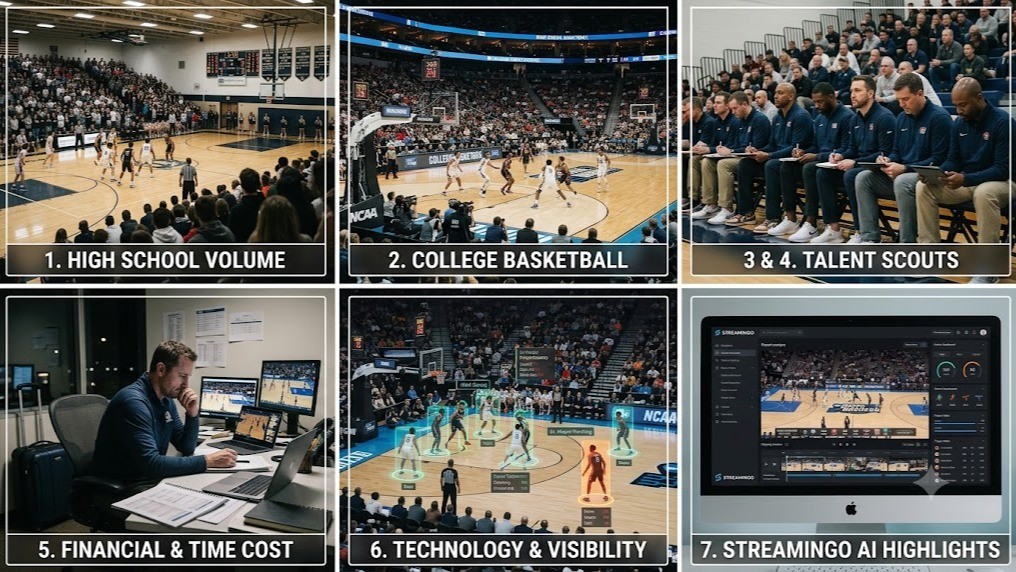
With tens of thousands of high school and college basketball games played weekly across the United States, traditional talent scouting faces severe operational bottlenecks. Relying on an estimated 6,000 to 10,000 college evaluators and limited traveling scouts, the industry spends up to $150 million annually on recruiting travel, yet leaves thousands of capable players overlooked due to geographic constraints and time-consuming manual film review.
Artificial intelligence reshapes this process by democratizing player exposure and increasing evaluation efficiency tenfold. Streamingo's automated spatio-temporal video intelligence platform addresses these challenges by generating player-specific highlight reels, decoding tactical IQ, and providing precise tracking, so more student-athletes get visibility with collegiate and professional scouts nationwide.
1. High School Basketball Games Played Per Week#
- Statistical volume: across the United States, over 18,000 high schools field interscholastic basketball programs, representing over 540,000 boys and 400,000 girls participating in varsity competition (NFHS Participation Survey).
- Weekly schedule: high school varsity teams typically play 2 to 3 regular-season games per week over a 12–14 week season (GSS Institute Basketball Study). With roughly 36,000 varsity teams (boys and girls combined), an estimated 36,000 varsity games are played every week during peak winter months. Adding junior varsity (JV), freshman teams, and weekend AAU club tournaments, total volume reaches 70,000 to 100,000 games per week.
2. College Basketball Games Played Per Week#
- Statistical volume: across NCAA Divisions I, II, and III, as well as NAIA and NJCAA (junior college) institutions, there are over 3,000 college basketball teams nationwide.
- Weekly schedule: college teams average 2 official games per week across a 15-week regular season (NCAA Competition Overview), or approximately 3,000 college games every week across all divisions during peak season.
3. High School Basketball Talent Scouts Available#
- Full-time independent scouts: dedicated, full-time high school scouts are relatively few. Scouting at this level is largely anchored by national media evaluation networks and independent services such as Prep Hoops, 247Sports, Rivals, On3, and HoopSeen. Nationwide, there are an estimated 500 to 1,500 dedicated high school scouts and regional recruiting analysts.
- Coaching staff scouts: the vast majority of high school evaluation is conducted directly by college assistant coaches during official NCAA "live" evaluation periods (Sports Reelz Recruiting Analysis).
4. College Basketball Talent Scouts Available#
- College recruiting personnel: across over 3,000 college programs, including 366 NCAA Division I teams plus Division II, Division III, NAIA, and JUCO schools, coaching staffs double as primary talent evaluators. Under NCAA Division I personnel and coaching rules, programs deploy designated assistant coaches and video coordinators authorized for off-campus scouting. This creates an active evaluation workforce of approximately 6,000 to 10,000 people scouting high school prospects and transfer portal players during official live evaluation periods.
- Professional NBA and G League scouts: all 30 NBA franchises maintain dedicated talent identification departments. As detailed in NBA Scouting Operations Structure, organizations employ directors of player personnel, regional college evaluators, and advance scouts, a network of roughly 250 to 300 full-time professional scouts monitoring top collegiate talent.
- NCAA-approved independent scouting services: college athletic departments supplement in-person evaluation with third-party scouting databases. Programs buy subscriptions to independent networks operating under NCAA-approved recruiting and scouting service regulations to access standardized prospect evaluations, game breakdown videos, and athletic rankings.
| Tier | Estimated evaluators | Primary role |
|---|---|---|
| High school scouts and analysts | 500–1,500 | Independent and media evaluation (Prep Hoops, 247Sports, Rivals, On3, HoopSeen) |
| College coaches and evaluators | 6,000–10,000 | Scouting high school prospects and transfer portal players in live evaluation periods |
| NBA full-time scouts | 250–300 | Monitoring top collegiate talent for 30 franchises |
5. The Financial and Operational Cost of Talent Scouting#
- Direct travel and program spending: major NCAA Division I Power Conference programs frequently spend $100,000 to $300,000+ annually on basketball recruiting travel alone, including airfare, hotels, event admissions, and video database subscriptions (Athletic Director U Recruiting Cost Breakdown). Mid-major, Division II, and Division III programs spend $5,000 to $50,000 annually.
- Aggregate industry cost: across 3,000+ college programs, total annual spending on recruiting travel, showcase passes, and video services reaches $50 million to $150 million.
- Human capital bottlenecks: beyond money, scouts and assistant coaches spend 20 to 30 hours per week manually watching raw game film, clipping highlights, or traveling cross-country. This manual burden restricts evaluation to top-tier prospects and major tournament circuits, leaving thousands of capable players unreviewed.
| Program tier | Annual recruiting travel and video spend |
|---|---|
| NCAA Division I Power Conference | $100,000–$300,000+ |
| Mid-major, Division II, Division III | $5,000–$50,000 |
| All 3,000+ college programs combined | $50 million–$150 million |
Transforming Scouting: The Impact of Universal Technology & Automated Visibility#
Integrating artificial intelligence and automated video analytics into high school and college basketball democratizes exposure and changes how talent is identified:
- Eliminating regional blind spots: traditional in-person scouting heavily favors elite prep schools and major metropolitan shoe circuits (for example, Nike EYBL and Adidas 3SSB). AI-enabled video platforms let prospects from rural districts, small mid-major colleges, or junior colleges be discovered regardless of geography.
- Exponential efficiency gain: a scout can realistically evaluate 2 to 3 live games a day, or 3 to 4 full unedited game recordings. Automated video indexing condenses full-length footage into player-specific action reels in minutes, enabling a single scout to evaluate 10x to 20x more athletes per week.
- Context-rich, objective analytics: traditional evaluation leans on points per game and basic box scores. AI tracking adds spatial metrics such as off-ball movement, defensive rotations, contest percentages, transition speed, and decision-making under defensive pressure.
- Strategic budget optimization: programs can redirect travel spending toward verified targets identified through centralized video pipelines, sharply reducing wasted scouting trips.
Streamingo's Player Highlights Solution: Maximizing Efficiency & Accuracy#
Streamingo Basketball Analysis is a spatio-temporal video intelligence platform built to upgrade how game film is processed and evaluated:
- Automated spatio-temporal player tracking: Streamingo tracks every player frame by frame from raw match footage without expensive hardware or proprietary camera setups, accepting standard video URLs and film uploads.
- Instant player-specific highlight reels: the platform eliminates manual video tagging by coaches or families. It automatically isolates individual actions, such as pick-and-roll reads, perimeter contests, transition passes, and defensive rotations, so scouts can launch a prospect's full functional highlights with a single click.
- Decoded play patterns and tactical IQ: beyond individual highlights, Streamingo decodes offensive and defensive set patterns across possessions. Evaluators gain objective visibility into a player's basketball IQ, spatial awareness, and tactical fit within specific collegiate or professional schemes.
- High turnaround and accuracy: Streamingo backs its proprietary computer vision algorithms with human expertise, delivering NBA-caliber analysis and verified player highlight reels with rapid turnaround, so recruiting departments can evaluate thousands of school and college players with minimal overhead.
Figures are industry estimates attributed to the sources named in the text. Totals such as weekly game counts are derived from team counts and typical schedules, so treat them as order-of-magnitude estimates rather than official counts.
Ready to Bridge the Scouting Gap? Experience Streamingo Today#
The future of basketball recruiting isn't trapped in endless cross-country flights or buried under hundreds of hours of unedited game film. Modern talent identification belongs to programs and athletes who use automated video intelligence to make faster, smarter, and more equitable scouting decisions.
Whether you are building a championship college program or making sure your student-athletes get the national exposure they deserve, Streamingo's Player Highlights Solution turns raw video into actionable scouting intelligence in minutes.
Experience Streamingo TodayGlossary of Key Terms#
- Live Evaluation Period
- An official NCAA window during which college coaches may evaluate high school prospects in person at games and events.
- Transfer Portal
- The NCAA system through which college athletes who intend to transfer are listed, creating a pool of prospects that programs scout.
- Shoe Circuit
- Brand-sponsored elite youth basketball circuits, such as Nike EYBL and Adidas 3SSB, where recruiting attention concentrates.
- Spatio-Temporal Video Intelligence
- AI video analysis that tracks players across continuous space and time, enabling frame-by-frame tracking, action detection, and play-pattern recognition.
- Player-Specific Highlight Reel
- An automatically generated compilation of a single player's plays, isolated from full-game footage without manual tagging.
- Tactical IQ (Basketball IQ)
- A player's spatial awareness, decision-making, and fit within offensive and defensive schemes, inferred objectively from decoded play patterns.
- Off-Ball Movement
- A player's movement away from the ball, such as cuts and spacing, which box scores don't capture but spatial tracking can measure.
Frequently Asked Questions#
How many high school basketball games are played per week in the US?
An estimated 36,000 varsity games per week in peak winter months, rising to 70,000–100,000 when JV, freshman teams, and weekend AAU tournaments are included.
How many college basketball games are played per week?
Roughly 3,000 per week at peak season, from over 3,000 teams across NCAA I, II, III, NAIA, and NJCAA averaging about 2 games a week.
How many basketball scouts are there in the United States?
An estimated 500–1,500 dedicated high school scouts and analysts, 6,000–10,000 college coaches and evaluators, and 250–300 full-time NBA scouts.
How much does college basketball recruiting cost?
$100,000–$300,000+ per year for Division I Power Conference programs, $5,000–$50,000 for mid-major, Division II, and Division III programs, and an estimated $50M–$150M across all 3,000+ college programs.
How much time do scouts spend watching game film?
An estimated 20 to 30 hours per week on manual film review, clipping, or travel, which restricts evaluation to top-tier prospects and major tournaments.
How does AI improve basketball scouting?
It removes regional blind spots, condenses games into player-specific reels in minutes (10x–20x more athletes evaluated per scout), adds objective spatial metrics, and helps redirect travel budgets toward verified targets.
What does Streamingo's basketball player highlights solution do?
It tracks every player frame by frame from standard video URLs or uploads, generates player-specific highlight reels automatically, decodes play patterns and tactical IQ, and combines computer vision with human expertise for verified results.
Why are so many capable basketball players overlooked by scouts?
In-person scouting favors elite prep schools and shoe circuits, and manual film review can't cover tens of thousands of weekly games, so players from rural districts, smaller colleges, and junior colleges are often never evaluated.