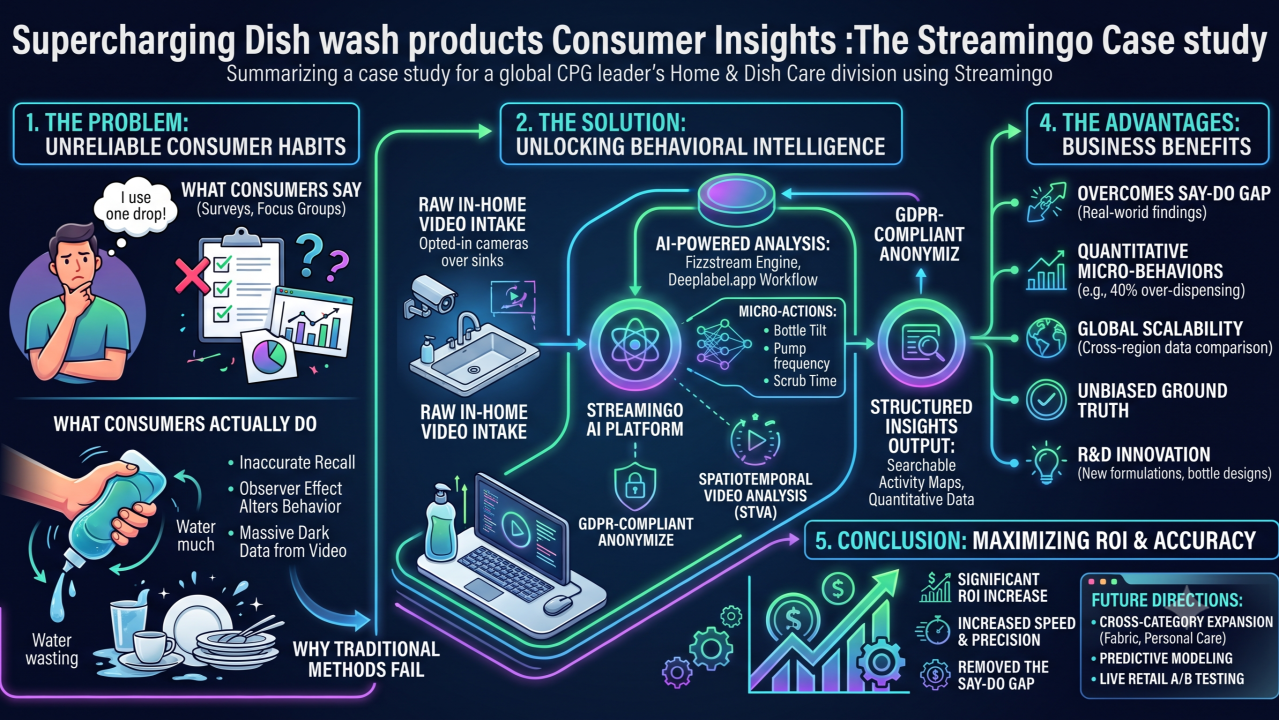
(a) The Problem#
For a global CPG major, the dish wash division was a massive operation, generating multiple billions of dollars in annual revenue and backed by a multi-million-dollar annual budget for consumer insights.
To protect market leadership and drive innovation, the division invested heavily in understanding consumer behavior through surveys, questionnaires, focus group studies, and quantitative consumption measurement using sensors. Yet despite that investment, the results fell short:
- Survey data proved of limited use to HomeCare R&D, because it couldn't show exactly how dish wash products were used in the consumer's home.
- Consumer Insights teams struggled to uncover the objective truth of behavior. Research leaned heavily on self-reported data from surveys, questionnaires, and focus groups, so teams lacked satisfactory evidence of real-world behavior.
- Sensors provided raw data on volumetric changes, but lacked visual context and couldn't capture why or how the product was handled.
The brand wanted deep insights into product usage to support critical business decisions and to validate a few core assumptions made during product development. None of this was possible with the existing methods.
(b) Why the Problem Was Unsolvable with Traditional Methods#
The root of the issue was the "say-do gap": a costly blind spot in market research where what consumers say they do differs greatly from what they actually do. Traditional methodologies fell short on several fronts:
| Method | Limitation |
|---|---|
| Surveys and questionnaires | Subjective recall: memory is notoriously inaccurate for mundane, subconscious chores like washing dishes |
| Focus groups and observed kitchens | The observer effect: artificial kitchens or researchers in the home alter natural behavior, since people perform tasks more carefully when watched |
| At-home camera ethnography | The data deluge: 200 hours of raw, unstructured video became "dark data"; human teams couldn't manually tag and quantify thousands of hours at global scale |
| Volumetric sensors | No visual context: they recorded how much product changed, not why or how it was handled |
(c) Introducing Streamingo into the Workflow#
The workflow needed to help stakeholders across Product R&D, Consumer Market Insights, and Data Science use business-critical insights to close the say-do gap, and to scale genuine in-home ethnography worldwide. The CPG leader integrated Streamingo into its consumer insights workflow.
Streamingo is an AI-powered operating system for spatiotemporal human activity analysis. It converts raw, unstructured video into structured behavioral intelligence without new, specialized hardware. Opted-in consumers were given standard, non-intrusive cameras positioned near their kitchen sinks, and the company began routing raw domestic cleaning footage directly into Streamingo's analytics ecosystem.
(d) How the Streamingo Methodology Works#
Streamingo applied a three-stage AI methodology that tracks spatiotemporal interactions at scale:
- Unified intake and privacy redaction (Anonymize): raw video from standard cameras flows into the platform. Because in-home video carries significant privacy and compliance risk, the built-in Anonymization engine performs GDPR-compliant video redaction at the source, masking personal identifiers (faces, irrelevant background context) before analysis begins.
- Behavioral synthesis via FizzStream and Deeplabel.app: FizzStream, the core inference engine for Spatio-Temporal Video Analysis (STVA), uses models trained on Deeplabel.app, Streamingo's proprietary annotation workflow, to automatically detect and log sub-second micro-actions. It identifies complex human-object interactions such as the tilt angle of a soap bottle, the number of pumps used, the grip on the sponge, and time spent scrubbing versus rinsing.
- Strategic execution via Activity Maps: unstructured video becomes a searchable, structured Activity Map. The insights team uses an internal dashboard where footage is translated into quantitative business intelligence, turning qualitative visual moments into large, comparable datasets across global demographics.
(e) How the Customer Benefited#
Streamingo gave the CPG leader an objective, data-driven view of authentic in-home product use, turning visual moments into operational intelligence. Key benefits:
- Real-world validation of new product introductions: Product R&D and Consumer Insights teams could observe directly whether NPIs performed and were used in practice as intended during formulation and structural design.
- Management decisions backed by ground-truth behavior: strategic choices, from capital allocation for packaging redesigns to portfolio expansion, were anchored in observed consumer behavior rather than distorted self-reported data.
- Cross-geographic behavioral analysis and regional formulations: studying habits across multiple global markets at once surfaced regional differences, such as water temperature, scrubbing duration, and dosing frequency, supporting tailored formulations and packaging formats for specific geographies.
- Actionable field suggestions from natural settings: unfiltered footage showed how consumers physically handled, stored, and applied products around the sink, directly informing bottle ergonomics, nozzle design improvements, and clearer-use labeling.
(f) Conclusion: Accelerating ROI and Accuracy#
For the Home and Dish Care division, integrating Streamingo brought several clear advantages:
- Accuracy: insight accuracy rose significantly, with pipeline accuracy of 85–92% across different dish washing actions.
- Speed: raw footage was synthesized into actionable data quickly. Video from one day across 50 cameras became actionable data in 2 days, shortening time to insight.
- NPI validation: new product introductions were validated very quickly.
- Claims support: some groups used the approach to help validate product-superiority claims versus competitors.
Future Work and Directions
Looking ahead, the partnership between the CPG leader and Streamingo can expand across several fronts:
- Cross-category expansion: extending the dish care deployment to other kitchen product categories to standardize behavioral intelligence across the brand's kitchen portfolio.
- Predictive behavioral modeling: using historical AI-tagged video data to build models that forecast how consumers will react to future packaging prototypes before physical molds are made.
- Merging demographic and usage data: combining demographic data with product usage data for deeper, more accurate insights that can positively affect revenue.
The customer is anonymized at its request. Results reflect this specific deployment and may vary by product category, market, and study design.
Supercharge Your Product Category Insights
We'd be happy to talk through how in-home video intelligence could close the say-do gap in your category.
Reach out: sales@streamingo.aiGlossary of Key Terms#
- Say-Do Gap
- The difference between what consumers say they do in surveys and focus groups and what they actually do.
- Observer Effect
- The change in people's natural behavior caused by knowing they are being watched, such as performing tasks more carefully.
- Dark Data
- Collected data, such as hundreds of hours of raw ethnographic video, that goes unused because it cannot be manually tagged and analyzed at scale.
- Spatio-Temporal Video Analysis (STVA)
- Analysis of video across continuous space and time to detect actions, interactions, and their durations.
- FizzStream
- Streamingo's core inference engine for spatio-temporal video analysis, which detects and logs sub-second micro-actions and human-object interactions.
- Deeplabel.app
- Streamingo's proprietary data annotation workflow used to train the models that power FizzStream.
- Activity Map
- A searchable, structured representation of video footage that turns visual moments into quantitative, comparable behavioral datasets.
- New Product Introduction (NPI)
- The launch of a new product, whose real-world usage can be validated against its intended design using observed behavior.
Frequently Asked Questions#
Why did traditional consumer research fall short for dish wash products?
Surveys and focus groups relied on unreliable self-reports, sensors lacked visual context, observed studies triggered the observer effect, and home video created "dark data" that humans couldn't tag at scale.
What is the say-do gap in market research?
The difference between what consumers say they do and what they actually do, a costly blind spot especially for subconscious chores.
How did Streamingo capture dish wash behavior without special hardware?
Opted-in consumers used standard, non-intrusive cameras near their kitchen sinks, and the footage was routed into Streamingo's analytics platform.
How does Streamingo's three-stage methodology work?
Anonymize masks faces and background context at the source; FizzStream, trained with Deeplabel.app, logs sub-second micro-actions like bottle tilt, pump count, sponge grip, and scrub time; and an Activity Map turns footage into comparable quantitative datasets.
What results did the CPG company achieve?
85–92% action accuracy, insights in 2 days from a day of 50-camera footage, fast NPI validation, and support for product-superiority claims.
How did cross-geographic analysis help product R&D?
It revealed regional differences in water temperature, scrubbing duration, and dosing frequency, enabling tailored formulations and packaging per geography.
How does Streamingo handle privacy for in-home video?
A built-in Anonymization engine performs GDPR-compliant redaction at the source, masking faces and irrelevant background before analysis begins.
What future applications does the case study point to?
Cross-category kitchen expansion, predictive packaging models, and merging demographic data with usage data.